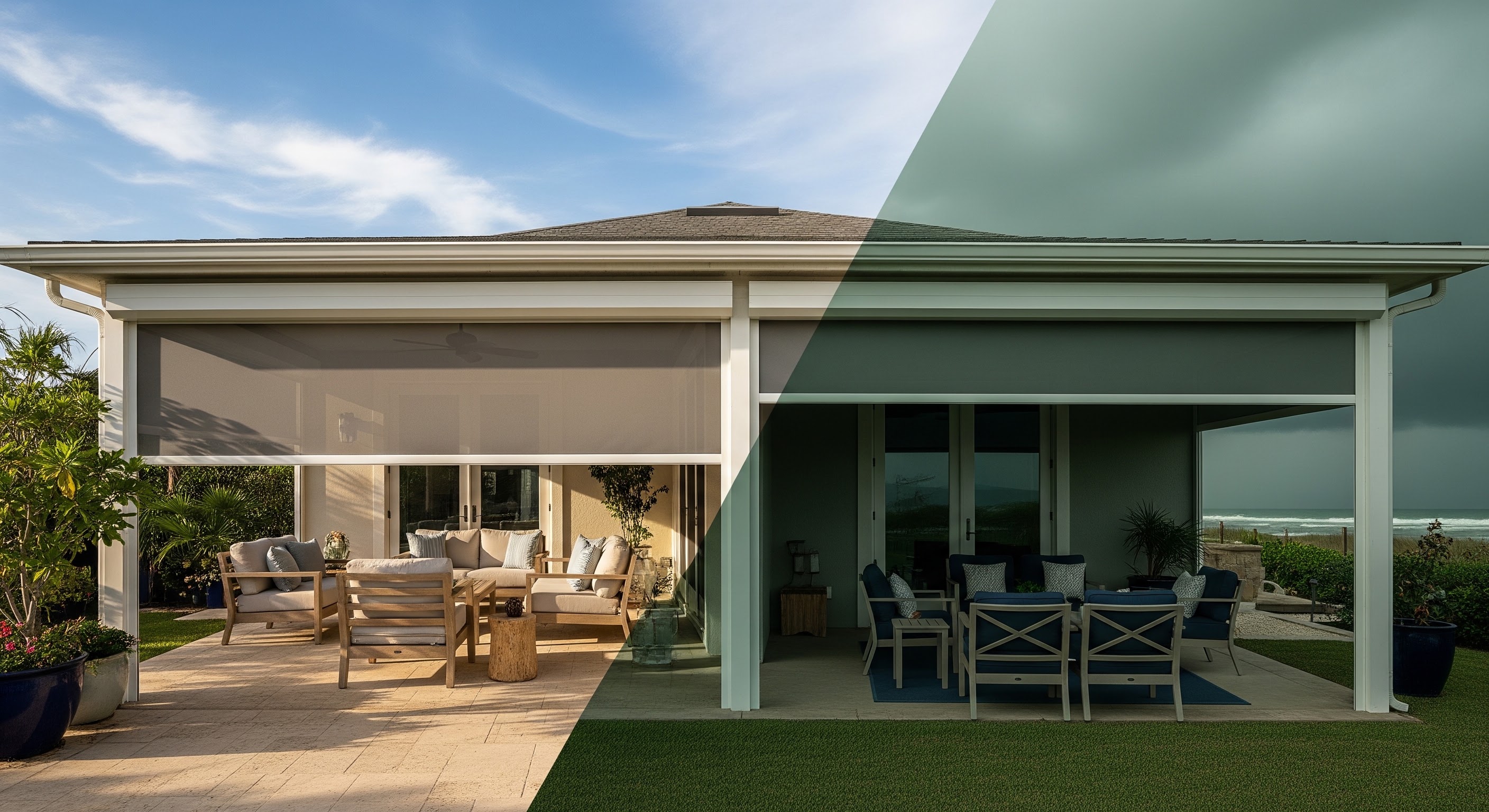
OneTrack or MaxForce: Specifying for a Space That Has to Perform Labor Day Weekend — and All the Way Through Hurricane Season
OneTrack or MaxForce: Specifying for a Space That Has to Perform Labor Day Weekend — and All the Way Through Hurricane Season
Post 1 in this series named four documentation gaps worth checking before citing any motorized screen spec in a submittal package. This one is the decision those gaps eventually lead to: OneTrack or MaxForce. Both are motorized track systems from the same manufacturer, and both show up on nearly identical residential and commercial project lists. They are not, however, interchangeable — and Labor Day weekend, immediately followed by the Atlantic hurricane season's climatological peak, is exactly the calendar window that makes the difference between them concrete rather than academic.
OneTrack: the right default for a standard project
For a patio or lanai screen project outside a High-Velocity Hurricane Zone, where wind is a comfort factor rather than a code trigger, OneTrack is the system NextGen Screens positions as the general-purpose track solution. It's the right default when the client's priority is day-to-day usability — quiet operation, standard wind resistance, straightforward integration with the automation platforms already documented elsewhere on this site — rather than a specific storm-hardening requirement written into the jurisdiction's building code.
MaxForce: built for the code requirement, not just the storm
MaxForce exists because Florida Building Code requires motorized screen systems in HVHZ jurisdictions — Miami-Dade and Broward counties specifically — to carry a Miami-Dade County Notice of Acceptance. That's a compliance requirement, not a marketing claim: a project physically located in one of these counties does not have the option of specifying a system without that documentation, regardless of how the client feels about storm risk generally. Third-party coverage describes MaxForce as engineered specifically to meet this bar. What NextGen Screens' own site does not yet publish is the NOA number itself — the identifier a plans examiner will actually ask for at permit review, not the word "certified" on its own.
Why Labor Day weekend is the real-world test for this decision
Labor Day weekend, September 5–7, 2026, is the last major outdoor-entertaining weekend of the summer — the point at which a newly completed space genuinely has to perform for a client's holiday gathering, whether that's a residential backyard or a commercial outdoor dining area. It is also, as a real 2026 calendar fact rather than an invented urgency, just three days ahead of September 10 — the Atlantic hurricane season's climatological peak per NOAA's National Hurricane Center. A space specified with OneTrack because it only needed to look good for one weekend is a different bet than a space specified with MaxForce because it needs to hold up through the roughest stretch of the season starting the following week. Naming both requirements honestly, rather than defaulting to whichever system is easier to spec, is the actual job here.
The next post in this series is a shorter, practical one: a weekend-before checklist for verifying whatever system is already installed, timed to the same Labor Day weekend / hurricane-peak window — published September 3.
Frequently Asked Questions
Is MaxForce required outside Miami-Dade and Broward counties?
Not by the same HVHZ-specific code trigger. Outside HVHZ jurisdictions, Florida Building Code and most other states require wind-load compliance per ASCE 7 based on the project's design wind speed and exposure category, which OneTrack is positioned to meet as a general-purpose system. Whether MaxForce's additional wind-load margin makes sense outside HVHZ is a project-specific judgment call, not a code requirement.
Can I get the MaxForce NOA number directly from NextGen Screens?
It is not published on the specification site as of this writing. A specifier who needs it for a permit submittal should request it directly from the manufacturer and independently confirm it against Miami-Dade or Broward County's public product-approval registry before citing it in construction documents.
Does the hurricane season's timing actually affect which system to spec?
The calendar doesn't change the code requirement — HVHZ jurisdiction determines whether MaxForce-level compliance is mandatory, regardless of season. What the season's timing does is raise the practical stakes of getting the choice right: a system chosen for a Labor Day deadline that also has to perform through September and October's historically higher storm activity is a different specification problem than one that only needs to look good for a single weekend.
Sources
NextGen Screens. Self-observed site content, FAQ, and navigation. Accessed August 19–24, 2026. nextgenscreens.com
Fenetex Corporation. One-Track Motorized Retractable Screens. Manufacturer product site, referenced for product-line identification only — not restated as a verified spec. onetrackscreens.com
Fenetex Corporation. MaxForce Hurricane Track Systems. Manufacturer product site, referenced for product-line identification only — not restated as a verified spec. maxforcescreens.com
NOAA National Hurricane Center. Atlantic hurricane season climatology — September 10 peak. Accessed August 2026.
General reference: Miami-Dade County and Broward County both maintain public Notice of Acceptance (NOA) product-approval registries; no specific NOA number for MaxForce was located or confirmed in this research. Disclosed evidence gap — see EXR-NGS-1, carried forward from post 1.
