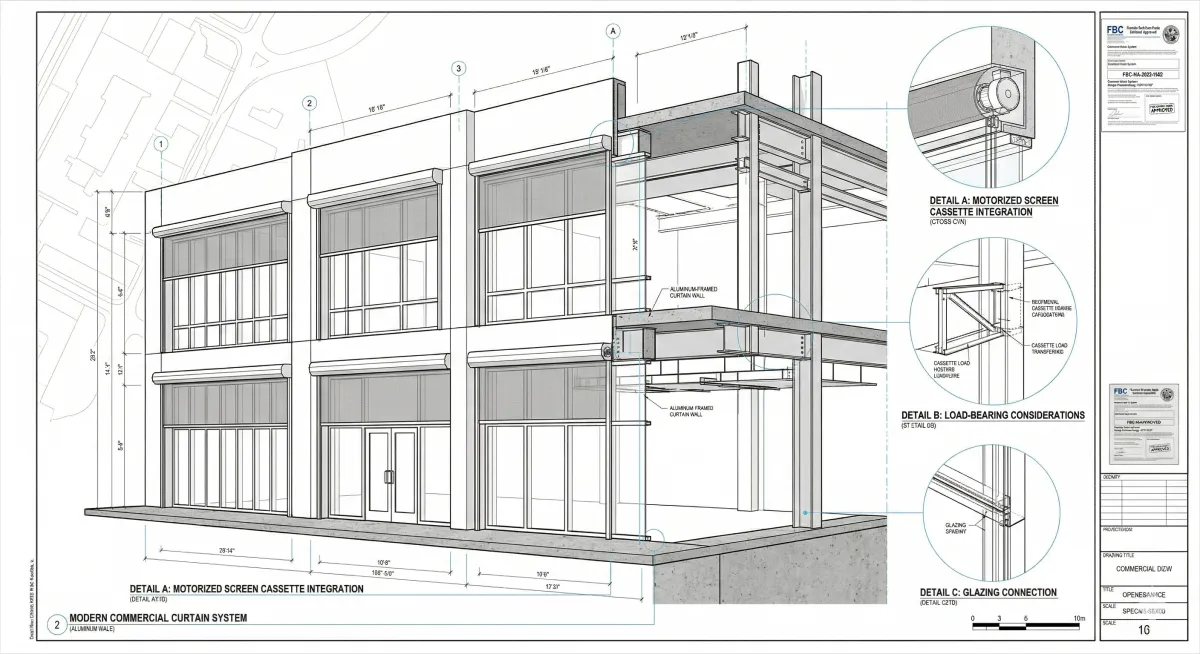
Specifying Motorized Screens for Commercial Projects: Load-Bearing, Code, and Integration Standards
Commercial Projects Introduce Specification Demands That Residential Practice Does Not Resolve
A motorized screen specification on a single-family residence involves a defined set of variables: wind load, product approval, substrate, motor, and electrical coordination. The specification envelope is manageable within the residential construction document set, and the interdependencies are limited to the structural and MEP consultants.
Commercial motorized screen specifications operate in a substantially more complex environment. The screens span wider openings, transferring higher concentrated loads to structural framing that must be confirmed adequate by a licensed structural engineer. The project is governed by the International Building Code rather than residential provisions, introducing occupancy-specific requirements for means of egress, emergency operation, and fire performance. ASHRAE 90.1 energy compliance analysis must account for the screen's solar optical properties as part of the fenestration assembly's whole-building energy model. Building automation system integration requires protocol coordination with the BAS contractor, the electrical engineer, and potentially the MEP commissioning agent. And in commercial coastal construction, the product certification requirements under the Florida Building Code or equivalent state code apply with the same force as in residential work, but with commercial occupancy exposure consequences that are materially more severe.
Architects who understand the full scope of commercial motorized screen specification produce construction documents that address each of these dimensions without gaps. The technical library at Next Gen Screens provides product-specific data to support this specification process across commercial project types.
Large-Span Structural Load Analysis: What Changes at Commercial Scale
The structural load transfer generated by a wide-span motorized screen is the most significant engineering distinction between residential and commercial motorized screen specifications. While residential screens typically span openings up to 16 to 20 feet in width, commercial screens in restaurant, hospitality, retail, and office applications routinely span 20 to 40 feet or greater. The difference in load magnitude is not linear; it scales with both span width and design wind pressure, and the resulting header attachment loads at commercial scale require formal structural analysis rather than the standard product approval anchor schedule that governs residential installations.
Calculating the Header Attachment Load at Commercial Scale
The total horizontal wind load applied to a motorized screen assembly is the product of the screen's projected area and the design wind pressure applicable to its location and building zone:
F_total = p × (W × H)
Where:
F_total = total applied wind force in pounds
p = design wind pressure in psf (from ASCE 7-22 Chapter 30, as covered in Blog 1 of this series)
W = screen clear span width in feet
H = screen deployed height in feet
For a commercial screen spanning 30 feet in width with a 12-foot deployed height at a design wind pressure of 50 psf negative:
F_total = 50 × (30 × 12) = 18,000 pounds
This 18,000-pound total force must be transferred through the header attachment into the supporting structural element above the opening. The force is distributed across the header's attachment points, but the header itself must be capable of spanning the full 30-foot opening while supporting both the screen's dead load and the transferred wind load without exceeding allowable deflection limits.
Architects specifying large-span commercial motorized screens must formally coordinate with the structural engineer of record to confirm:
The structural element above each screen location (beam, spandrel, reinforced concrete band, steel tube section) has adequate section capacity to carry the transferred wind load without exceeding code-allowable deflection limits (typically L/360 for non-structural elements under the IBC 2021, Section 1604.3)
The connection between the screen header assembly and the structural element is designed as a structural connection, not a standard anchor pattern derived from the product approval installation details
Where the screen is attached to a curtain wall or storefront system, the glazing contractor has confirmed that the curtain wall mullion system is capable of transferring the screen's applied load into the building structure without compromising the glazing assembly's performance
Deflection Limits and Their Impact on Screen Operation
Structural deflection at the header attachment point directly affects motorized screen operation. If the header element deflects under wind load beyond the cassette housing's tolerance range, the reel tube can bow, the fabric can develop uneven tension across its width, and track alignment can be compromised. The maximum permissible deflection at the cassette attachment point under full design wind load should be confirmed with the screen manufacturer before the structural design is finalized. For most commercial tubular motor systems with Keder track retention, the maximum permissible mid-span deflection of the header element is in the range of L/500 to L/600, more restrictive than the IBC's general structural limit for non-structural elements.
IBC Occupancy Requirements: Means of Egress and Emergency Operation
The International Building Code governs commercial construction nationally and introduces occupancy-specific requirements that directly affect how motorized screens may be deployed and operated in commercial spaces. Architects specifying motorized screens for commercial projects must address two specific IBC provisions.
Means of Egress: IBC Section 1003 and 1005
Under IBC 2021 Section 1003.3, means of egress components, including the exit access, exit, and exit discharge, must remain unobstructed at all times the building is occupied. Motorized screens deployed across or adjacent to egress paths create a potential IBC compliance issue if the deployed screen position encroaches on the required egress width or obstructs access to an exit door.
Architects must evaluate each screen location against the following egress criteria:
Minimum egress width: IBC Section 1005.1 establishes minimum egress widths based on occupancy type and occupant load. The most common minimum for corridor and exit access is 44 inches (36 inches for occupant loads not exceeding 49). A deployed motorized screen that reduces a passageway to below the minimum egress width at any point creates a non-compliant condition.
Exit door accessibility: Where motorized screens are specified adjacent to or enclosing spaces containing exit doors, the screen must not deploy in a position that prevents the exit door from being opened to its full required clear width of 32 inches minimum (measured from the door face to the stop with the door open at 90 degrees) per IBC Section 1010.1.1.
Emergency power and fail-safe operation: For screens installed in commercial occupancies where the deployed position could affect means of egress, the motor control system must be integrated with the building's fire alarm system through an interface that causes the screens to retract automatically upon a fire alarm signal. This integration is typically accomplished through a dry-contact relay connected to the fire alarm panel output and wired to the motor control panel. The relay must be configured for fail-safe operation: if the relay loses power or signal, the screens default to the retracted (open) position, not the deployed position.
The fail-safe retract requirement should be explicitly noted in the motorized screen specification section and coordinated with the fire alarm system specification (typically CSI Division 28 31 00) and the electrical engineer's panel schedule.
Accessibility: ICC A117.1 and ADA Compliance
Where motorized screen tracks and sill channels are installed at floor level in paths of travel used by building occupants, the sill condition must comply with ICC A117.1-2017 Section 303 (Changes in Level) and ADA Standards for Accessible Design Section 4.5.2.
Under these standards, changes in level at floor surfaces on accessible routes are permitted as follows:
Up to 1/4 inch vertical: permitted without edge treatment
Between 1/4 inch and 1/2 inch vertical: must be beveled at a maximum slope of 1:2
Greater than 1/2 inch vertical: must be ramped per applicable ramp standards
Most recessed sill channels for motorized screens can be installed flush with the finished floor surface, eliminating the level change entirely. Where flush installation is not feasible, the sill channel profile must be confirmed to meet the 1/4-inch maximum vertical change or be beveled at 1:2 before the product is ordered. Architects should verify sill channel profile dimensions with the manufacturer and document the accessible route coordination in the project's ADA compliance checklist.
Specifying Motorized Screens for a Commercial Project?
One Track's commercial technical documentation includes large-span structural data, NFPA 701 fabric compliance records, and BAS integration specifications formatted for commercial submittal packages. Access One Track's commercial resources at onetrackscreens.com
ASHRAE 90.1 Energy Compliance Integration
For commercial projects subject to ASHRAE 90.1 energy compliance, exterior motorized screens deployed at the building's glazed skin function as dynamic shading devices that affect the fenestration assembly's effective Solar Heat Gain Coefficient (SHGC). When motorized screens are included in the project's energy model, the architect must provide the screen fabric's published solar optical properties to the energy compliance engineer for integration into the whole-building energy analysis.
How Exterior Dynamic Shading Devices Are Modeled Under ASHRAE 90.1
ASHRAE 90.1-2022 Section 5.5.4 addresses dynamic exterior shading devices, including motorized exterior screens that are controlled based on sun position, occupancy, or building automation commands. When properly specified and integrated into the building automation system, dynamic exterior screens can contribute to the fenestration assembly's compliance with the SHGC requirements of ASHRAE 90.1 Table 5.5-5 (Envelope Requirements by Climate Zone).
The energy modeling approach for dynamic exterior shading depends on the project's energy compliance pathway:
Prescriptive path: Under the prescriptive compliance path, the effective SHGC of the fenestration assembly with the exterior screen deployed is calculated by multiplying the glazing's published SHGC by the screen fabric's solar transmittance (Tsol). The effective SHGC must equal or fall below the ASHRAE 90.1 climate zone limit for the fenestration type and orientation. This calculation requires the glazing manufacturer's published SHGC and the screen fabric manufacturer's published Tsol, both at normal incidence.
Energy cost budget (ECB) path or whole-building simulation: Under simulation-based compliance, the screen's dynamic behavior (deployed vs. retracted schedule based on solar position or occupancy) is modeled using the fabric's full solar optical property set: Tsol, solar reflectance (Rsol), visible light transmittance (Tvis), and hemispherical emissivity. The Lawrence Berkeley National Laboratory's EnergyPlus simulation software includes shading device modeling capabilities that accept these inputs directly.
Documentation Required for Energy Compliance Submittal
For commercial projects where exterior motorized screens contribute to ASHRAE 90.1 compliance, the following documentation must be prepared:
Screen fabric manufacturer's published solar optical data sheet confirming Tsol, Rsol, and Tvis at normal incidence
Written confirmation from the fabric manufacturer that the published values are tested per NFPA 701 or equivalent standard
Energy model inputs documentation showing how the screen's optical properties were applied in the compliance analysis
BAS sequence of operations confirming the conditions under which screens deploy and retract (confirming that the deployment schedule used in the energy model reflects actual building operation)
The coordination between the screen specification and the energy model must be completed before the permit set is issued. Post-permit changes to the screen fabric selection that alter the Tsol value may require re-analysis of the energy compliance calculation and potential redesign of other envelope components to maintain compliance.
NFPA 701 Flame Spread Requirements for Commercial Fabric Specifications
In commercial occupancies governed by the IBC, interior and exterior fabric materials used in permanent building installations must comply with NFPA 701: Standard Methods of Fire Tests for Flame Propagation of Textiles and Films. This requirement applies to motorized screen fabrics in commercial buildings and is distinct from the UV stability and solar performance data that governs residential fabric selection.
What NFPA 701 Tests and What Compliance Requires
NFPA 701 establishes two test methods:
Test Method 1: Applied to fabrics used in single layer or where individual fabric or film elements cannot be separated. The test exposes a vertical fabric specimen to a controlled flame for a specified duration, then measures whether the fabric continues to burn after the flame is removed and whether melted drips ignite a cotton pad below the specimen.
Test Method 2: Applied to multi-layer fabric assemblies, barrier systems, or coated fabrics. More demanding than Test Method 1 in terms of specimen size and flame application duration.
Commercial motorized screen fabrics must carry documentation confirming compliance with the applicable NFPA 701 test method for the specific fabric construction being specified. Most quality commercial-grade PVC-coated polyester and fiberglass-core screen fabrics are formulated with flame-retardant compounds in the coating and carry NFPA 701 test reports from accredited laboratories. Architects must:
Confirm with the screen manufacturer that the specific fabric being specified carries NFPA 701 test documentation
Obtain a copy of the test report for inclusion in the project's fire performance submittal
Verify that the test was conducted on the fabric in the same construction and coating configuration as the product being specified; test reports for a different coating weight or fabric construction do not transfer
Where the local Authority Having Jurisdiction (AHJ) enforces NFPA 701 compliance for exterior building fabrics, the test report must be submitted with the permit application and available for review at inspection. Architects specifying commercial motorized screens in jurisdictions with active AHJ enforcement of NFPA 701 should confirm compliance documentation availability with the manufacturer before the design development phase concludes.
Multi-System Building Automation Integration: Protocol and Sequence of Operations
Commercial motorized screen installations in office buildings, hotels, mixed-use developments, and institutional projects are typically integrated into the building's central Building Automation System (BAS) rather than operated by individual wall switches or room-level remote controls. This integration introduces coordination requirements between the motorized screen specification, the BAS specification (typically CSI Division 23 09 00 or 25 00 00), and the electrical engineer's low-voltage systems design.
BAS Integration Protocols for Motorized Screens
The two primary BAS integration approaches for commercial motorized screens are relay-based hardwired integration and network protocol integration.
Relay-based integration: The BAS sends a dry-contact closure signal through a dedicated relay output to the motorized screen's motor control panel. A contact closure on the UP relay commands screen retraction; a contact closure on the DOWN relay commands deployment. This approach is simple, reliable, and compatible with virtually all BAS platforms without protocol translation. Its limitation is that it provides one-way command capability only: the BAS can command the screen but cannot receive position feedback or fault status from the screen system.
Network protocol integration (RS-485/SDN, BACnet, Modbus): More sophisticated commercial motorized screen systems support direct network communication with the BAS through RS-485, BACnet MS/TP, or Modbus RTU protocols. Network integration enables bidirectional communication: the BAS can issue deployment and retraction commands, receive screen position status (retracted, deployed, intermediate), receive motor fault alerts, and log operational data for energy analysis and maintenance scheduling. For LEED or WELL certification projects where operational data documentation supports certification points, network-protocol integration is the preferred approach.
Architects specifying commercial motorized screens should include the BAS integration method, the specific protocol, and the required interface hardware in both the motorized screen specification section and the BAS specification section. The two specification sections must be cross-referenced; an integration requirement described only in one section without coordination language in the other is a common source of scope gaps during contractor bidding.
Sequence of Operations: What the Architect Must Document
The sequence of operations (SOO) for the motorized screen system defines the conditions under which screens deploy and retract automatically, the priority hierarchy between automatic commands and manual overrides, and the behavior of the screens in emergency conditions. The SOO is typically developed by the architect in consultation with the mechanical and electrical engineers and documented in the specifications.
For commercial projects, a minimum SOO must address the following conditions:
Solar position deployment: Screens deploy automatically when the calculated solar angle and azimuth for the building's location and orientation produce direct solar radiation on the specified facade. Deployment conditions are typically defined by a solar altitude angle threshold (e.g., deploy when solar altitude exceeds 25 degrees on the west facade from 1:00 PM to sunset) and programmed into the BAS using an astronomical time clock with latitude and longitude inputs.
Occupancy-based override: Occupants in individual zones should have the ability to override the automatic deployment schedule within a defined range (e.g., retract the screen in an occupied space regardless of solar position, subject to a maximum retract duration before automatic re-deployment). The override duration and reset logic must be defined in the SOO.
Fire alarm integration: Upon fire alarm signal, all screens in the affected zone retract immediately and are locked out from deployment until the alarm condition is reset at the fire alarm panel. This is a mandatory provision for screens that could affect means of egress, as discussed earlier in this guide.
Wind speed interlock: For projects in coastal or high-wind environments, the SOO should include a wind speed interlock: when a building-mounted anemometer measures wind speeds above a specified threshold (typically 25 to 35 mph for standard solar screen fabrics; confirm with the manufacturer for the specific product), the screens retract automatically and are locked out from deployment until wind speed returns below the threshold. This interlock protects the fabric, the track system, and the motor from damage during high-wind events.
The wind speed interlock threshold must be specified in the SOO and confirmed against the manufacturer's operating wind speed limit for the screen system. Operating the screen above its rated operating wind speed can void the motor warranty and, in extreme cases, cause fabric or track failure.
The Next Gen Screens blog series provides complementary technical references for architects across the full series, including CAD integration protocols for architectural drawings (Blog 2), motor control protocol specifications for engineers (Blog 4 and Blog 7), and coastal high-wind zone specification guidance (Blog 11).
Commercial Procurement: Specification Section Placement and Submittal Requirements
Specification Section Placement for Commercial Projects
For commercial projects, the motorized screen specification section placement depends on the project's specification organization and the primary function of the screen system:
CSI Division 10 28 00 (Exterior Sun Control Devices): Appropriate for commercial projects where the screen's primary specified function is solar control, glare reduction, or energy management. This section coordinates with the mechanical engineer's HVAC load calculation and with the energy compliance documentation.
CSI Division 12 24 00 (Window Shades): Used on some commercial projects when the motorized screen is specified as a window treatment rather than a building envelope element. Less appropriate for exterior screens with structural load transfer requirements; more appropriate for interior motorized shade systems that do not interface with the building's structural system.
CSI Division 08 44 00 (Curtain Wall and Glazed Assemblies): For commercial projects where the motorized screen is integrated with a curtain wall or storefront system and the structural attachment is coordinated through the glazing contractor's scope, the screen specification may appear as a sub-section within the curtain wall specification or as a separate section cross-referenced from Division 08 44.
Commercial Submittal Package Requirements
Commercial motorized screen submittals carry more extensive documentation requirements than residential submittals. The complete commercial submittal package includes all items listed in Blog 2's residential submittal requirements, plus:
Large-span structural load calculation, stamped by the manufacturer's licensed structural engineer, confirming that the header attachment design is adequate for the calculated wind load at the project-specific design pressure
NFPA 701 test report for the specified fabric, from an accredited third-party laboratory, confirming compliance with the applicable test method
ASHRAE 90.1 solar optical data sheet (Tsol, Rsol, Tvis) for the specified fabric, confirming values used in the project's energy compliance analysis
BAS integration protocol documentation, including the interface hardware specification, the wiring diagram for relay integration or network protocol connection, and the sequence of operations as documented in the specification
Motor control panel specification, including the fire alarm interface relay configuration and the wind speed interlock wiring diagram
IBC means of egress analysis confirming that no deployed screen position encroaches on required egress widths or exit door clearances
For HVHZ commercial projects in Miami-Dade and Broward Counties, the Miami-Dade NOA documentation requirements described in Blog 5 apply with the same force as in residential construction. Builders specifying hurricane-rated commercial motorized screen systems in the HVHZ should reference Max Force Hurricane Screens for systems with current NOA certification applicable to commercial occupancy installations.
Conclusion: Commercial Motorized Screen Specification Is a Multi-Discipline Coordination Task
The gap between a residential motorized screen specification and a commercial one is not a matter of scale. It is a matter of scope. Commercial specifications require structural load analysis beyond standard product approval data, occupancy-specific code compliance under the IBC, energy modeling integration under ASHRAE 90.1, fire performance documentation under NFPA 701, and multi-system BAS coordination that must be addressed in both the mechanical and electrical specification sections simultaneously.
Architects who treat commercial motorized screen specification as an extension of residential practice will produce documents with coordination gaps that surface as RFIs, change orders, and commissioning failures. Architects who approach the commercial specification as a multi-discipline coordination task from the design development phase forward will produce construction documents that are complete, coordinated, and buildable without field interpretation.
Ready to develop the commercial specification for your next project? The technical resource library at Next Gen Screens provides commercial-scale product data, structural load documentation, and specification templates organized for the architect's workflow. Access the full library at nextgenscreens.com.