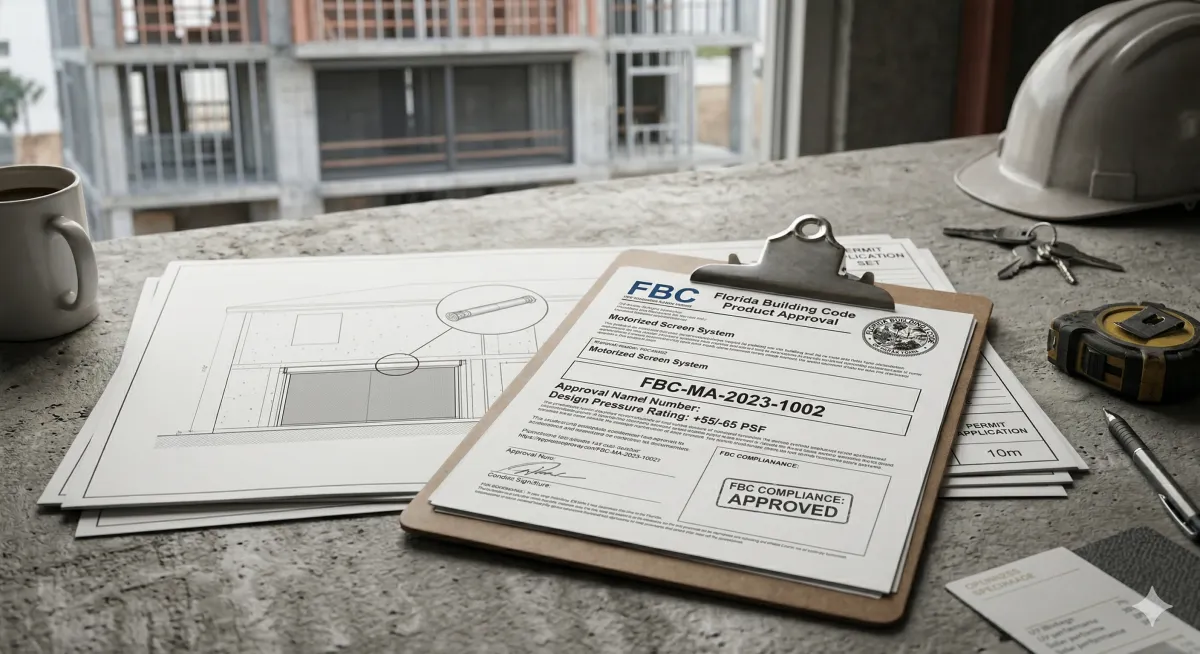
Florida Building Code Compliance for Motorized Screens: Product Approval, HVHZ, and NOA Requirements
Why Code Compliance for Motorized Screens Begins Before the Product Is Selected
A motorized screen installed without a valid product approval in a Florida permitted project is not simply a code violation. It is an uninsured liability for the builder, a permit failure at inspection, and a structure that cannot be legally occupied or transferred until the non-compliant installation is resolved. Resolving it after the fact means removal, re-specification, new permit submissions, and re-inspection: a sequence that costs more in schedule delays and rework labor than getting the compliance sequence right on the front end.
The Florida Building Code compliance framework for motorized screens is not complicated, but it has specific requirements that vary by geographic location within the state. A builder working in Sarasota County operates under a different certification tier than one working in Broward County, who in turn operates under different requirements than one working in Miami-Dade County. Understanding which tier applies, which certification is required, and what documentation the building department needs at permit submission and inspection is the complete scope of the compliance task.
This guide provides builders with a precise, jurisdiction-specific compliance reference for motorized screen installations across Florida. The technical library at Next Gen Screens supports this process with product approval references, installation documentation, and submittal resources organized for builder use.
The Florida Building Code Three-Tier Certification System
The Florida Building Code, 8th Edition (2023), establishes a three-tier product certification hierarchy for exterior opening protection components, including motorized screens. Each tier applies to a specific geographic area and carries distinct testing and documentation requirements. Builders must identify the applicable tier for each project before selecting a product.
Tier 1: Miami-Dade County Notice of Acceptance (HVHZ)
The highest certification tier applies exclusively to construction within Florida's High-Velocity Hurricane Zone (HVHZ), which encompasses Miami-Dade and Broward Counties. The HVHZ designation was established following the catastrophic building failures documented after Hurricane Andrew (1992) and codified in Florida Statute 553.73. Within the HVHZ, all exterior opening protection products must carry a valid Miami-Dade County Notice of Acceptance (NOA), issued by the Miami-Dade County Product Control Division.
The NOA certification process requires independent third-party testing to the Miami-Dade Test Application Standards:
TAS 201: Large missile impact test. A nine-pound two-by-four lumber section fired at 50 feet per second. Tests the product's ability to resist windborne debris penetration under conditions simulating a Category 4 to 5 hurricane.
TAS 202: Structural performance, water infiltration, and air infiltration testing. Confirms that the product maintains its structural integrity and sealing function under design wind pressures.
TAS 203: Cyclic wind pressure loading test. Subjects the product to 9,000 cycles of alternating positive and negative pressure at 1.5 times the design pressure. This test simulates sustained hurricane wind loading over time and is the most demanding element of the TAS protocol.
The TAS testing sequence exceeds the national ASTM E1886/E1996 standard in several critical parameters, particularly the cyclic pressure cycle count and the design pressure multiplier applied during TAS 203. A product that passes ASTM testing is not automatically qualified for HVHZ installation; TAS testing must be completed independently and specifically.
Each NOA is assigned a unique identifying number, must be renewed annually by the manufacturer through the Miami-Dade Product Control Division, and requires ongoing third-party manufacturing facility inspections and market surveillance testing to maintain validity. Builders can verify the current status of any NOA at the Miami-Dade County product search portal.
For builders coordinating HVHZ-compliant motorized screen specifications, Max Force Hurricane Screens provides systems carrying NOA documentation and TAS-compliant installation details for use in Miami-Dade and Broward County permit submissions.
Tier 2: Broward County Building Code (HVHZ Statewide Crossover)
Broward County falls within the HVHZ and therefore requires products that meet the same TAS 201/202/203 testing standards as Miami-Dade. However, Broward County operates its own building code compliance office and issues product approvals through its own review process. In practice, a valid Miami-Dade NOA is accepted in Broward County, and builders specifying systems with current NOA documentation do not require a separate Broward County product approval. Builders should confirm current acceptance policy with the Broward County Building Division at the time of permit submission, as local practice can vary.
Tier 3: Florida Building Code Product Approval (Statewide, Non-HVHZ)
For all Florida construction outside the HVHZ, exterior opening protection products must carry a valid Florida Building Code Product Approval, issued under the authority of Florida Statute 553.842 and administered by the Florida Building Commission. The statewide Product Approval system certifies that a product meets the Florida Building Code's performance requirements for the specific wind zone in which it will be installed.
For non-HVHZ statewide approvals, testing typically follows ASTM E1886/E1996 standards, with the design pressure values in the product approval document reflecting the tested performance limits. The key compliance requirement for builders: the design wind pressure calculated for the specific project site and building zone (per ASCE 7-22, as covered in Blog 1 of this series) must fall within the design pressure range certified in the product's Florida Product Approval. If the project's calculated design pressure exceeds the product's certified pressure limit, the product does not comply for that installation, regardless of its statewide approval status.
Florida Product Approvals are searchable by FL number, manufacturer, product category, and approval type in the Florida Building Commission's online database. Motorized screens are categorized under "Exterior Doors and Windows: Shutters" in the product approval search system.
Reading a Florida Product Approval Document: A Builder's Field Reference
The Florida Product Approval document is the primary compliance reference for a motorized screen installation in a permitted Florida project. It is not a marketing document. It is a code document, and it carries legal weight in the permit and inspection process. Builders who understand how to read a product approval document can verify code compliance independently, without waiting for a plan reviewer to identify a problem in the submittal.
The Six Critical Fields in Any Product Approval
1. FL Number (Product Approval Number) The FL number is the unique identifier for the certified product. This is the number that must appear in the permit submittal package, on the inspection card, and in any compliance documentation. Verify that the FL number on the product delivered to the job site matches the FL number in the submittal package. Products can look identical but carry different certifications.
2. Approved Use Confirms the product category and the use for which it is approved. For motorized screens, the approved use will specify opening type (window, door, large opening) and application category (opening protection, shutter). Confirm that the project's application matches the approved use exactly.
3. Maximum Design Pressure (Positive and Negative psf) The approval document states the maximum positive design pressure (wind pushing in) and maximum negative design pressure (wind pulling out) in pounds per square foot (psf) for which the product is certified. Both values must equal or exceed the design wind pressures calculated for the project site per ASCE 7-22. If either value is exceeded by the project's calculated pressure, the product is non-compliant for that installation location.
4. Approved Dimensions and Configurations The approval document specifies the maximum and minimum dimensions (width and height) for which the product is approved. Products installed at dimensions outside the approved range are not covered by the certification, even if the product is otherwise identical. This is one of the most frequently overlooked compliance requirements in field installations: a product approved for a maximum width of 14 feet installed at a 16-foot opening is a non-compliant installation.
5. Approved Substrates The approval document specifies the substrate types for which the installation is approved: masonry (concrete block, poured concrete, brick), wood frame (with specific minimum framing dimensions), or steel. The installation must use the substrate type shown in the approval. Variations in substrate that are not addressed in the approval require a product evaluation request to the Florida Building Commission or an alternative means and methods approval from the local building official.
6. Installation Instructions Reference The approval document incorporates the manufacturer's installation instructions by reference. These instructions are a code document, not a suggestion. The anchor type, anchor size, anchor spacing, embedment depth, and edge distance specified in the installation instructions are the minimum requirements for a compliant installation. Substitutions require engineering analysis and approval; they cannot be made arbitrarily in the field.
Need Florida Product Approval Documentation for Your Submittal Package?
One Track's technical resources include current FL approval numbers, installation documentation, and product data sheets formatted for Florida Building Code permit submissions. Access One Track's builder documentation at onetrackscreens.com
The Wind-Borne Debris Region: Where Opening Protection Is Mandatory
The Florida Building Code, 8th Edition (2023), Section 1609.1.2, defines the Wind-Borne Debris Region as areas within Florida where the basic wind speed is 130 mph or greater, plus areas within one mile of the coastal mean high waterline where the basic wind speed equals or exceeds 110 mph.
Within the Wind-Borne Debris Region, the Florida Building Code mandates opening protection on all glazed and non-glazed openings in the building envelope. This is not an optional upgrade. For residential construction, all windows, doors, skylights, and garage doors must be either:
Protected with an approved product (shutters, motorized screens, or other Florida-approved opening protection), or
Constructed of impact-resistant glazing assembly that meets the applicable impact and pressure testing standards
This mandate covers the entire coastal band of Florida from Pensacola through the Keys and up the Atlantic coast. Builders working in the Wind-Borne Debris Region who specify motorized screens as the opening protection solution must confirm that the screens carry a valid Florida Product Approval (or NOA in the HVHZ) before permit submission.
Locations Outside the Wind-Borne Debris Region
For projects located outside the Wind-Borne Debris Region, opening protection is not code-mandated. However, motorized screens installed in these locations on permitted projects still require a valid product approval if they are being installed as part of the permitted scope of work. The product approval confirms that the system has been independently tested and that the installation meets the Florida Building Code's performance standards for the wind zone applicable to the project location.
Builders specifying motorized screens for projects in non-debris-region locations should treat the product approval as a documentation requirement for the permit submittal, even when the system is being installed for solar control, insect screening, or other non-hurricane functions.
Permit Submission Requirements: What the Building Department Needs
The motorized screen permit submittal package must be complete and accurate before permit submission. Incomplete submittals are returned, and the time required to resolve deficiencies is schedule time lost. The following documents constitute a complete motorized screen permit submittal in Florida jurisdictions.
Required Documents for Statewide (Non-HVHZ) Projects
Florida Product Approval Document: The complete approval document downloaded from the Florida Building Commission product approval database. Confirm that the document is current (approval not expired), that the FL number matches the product being specified, and that the approved design pressures cover the project's calculated design pressures.
Manufacturer's Installation Instructions: The installation instructions referenced in the product approval document. These must be the version of the instructions that corresponds to the specific product approval version; installation instructions are revised with product approval revisions, and older versions may not reflect current approval requirements.
Shop Drawings: Dimensioned drawings showing the screen location, opening dimensions, cassette housing position, track layout, anchor locations and schedule, and substrate preparation notes. Shop drawings must be prepared by the manufacturer or an authorized installer and reviewed by the architect of record before submittal.
Design Wind Pressure Calculation: Documentation confirming the project's calculated design wind pressure per ASCE 7-22, including basic wind speed, exposure category, building height, and zone classification. This calculation confirms that the product approval's certified design pressures are adequate for the project location.
Electrical Permit (if required): Motor circuits require electrical permits in most Florida jurisdictions. Coordinate with the electrical contractor to confirm whether the motorized screen electrical work is included in the general building permit or requires a separate electrical permit application.
Additional Requirements for HVHZ Projects (Miami-Dade and Broward Counties)
Miami-Dade NOA Document: The complete, current NOA document downloaded from the Miami-Dade County product search portal. The NOA must be valid (not expired), must cover the specific product model being installed, and must include the installation details applicable to the project's substrate type.
NOA Installation Details: Miami-Dade NOAs include installation detail drawings that are part of the certified product approval. These drawings must be included in the permit submittal package and must be followed precisely during installation. Deviations from the NOA installation details constitute a violation of the product certification and require re-approval from the Miami-Dade Product Control Division before installation proceeds.
Miami-Dade Building Department Cover Sheet: Many Miami-Dade building department permit applications require a cover sheet that identifies the NOA number, the product category, the applicable TAS standards, and the design pressure values. Confirm current requirements with the local building department at the time of permit submission.
Inspection Protocol: What the Inspector Is Verifying
Understanding what a building inspector is specifically checking during a motorized screen rough inspection and final inspection allows builders to prepare the installation and the documentation to pass the first time.
Rough Inspection (Pre-Closeout)
At rough inspection, before drywall or finish materials conceal the header framing and electrical rough-in, the inspector verifies:
Header pocket framing dimensions match the product approval installation details
Substrate at anchor locations (masonry core fill, wood framing member size) matches the product approval requirements
Electrical conduit and wiring rough-in present at motor locations
Product approval or NOA document on-site and available for review
Builders should have the product approval document on-site during rough inspection, not just in the office file. Inspectors have the authority to fail an inspection if they cannot verify compliance with the product approval installation details at the time of inspection.
Final Inspection
At final inspection, after the motorized screen system is installed and operational, the inspector verifies:
Installed product matches the FL number or NOA number in the submittal package
Screen dimensions fall within the approved size range in the product approval
Anchors are the type, size, and spacing specified in the installation instructions
Motor is operational (deployment and retraction tested)
End-limit switches are set correctly (screen deploys to the designed stop position, retracts fully)
Track alignment is within manufacturer's tolerance specifications
Common Compliance Failures at Final Inspection
The following installation conditions are frequently identified as non-compliant at final inspection. Builders who brief their installation crews on these specific items before installation begins eliminate the most common causes of failed inspections.
Product installed outside approved dimensions: Confirm every opening dimension against the product approval's maximum approved width and height before the cassette and tracks are ordered. Once the product is fabricated, dimensional substitutions are not field-correctable.
Wrong anchor type or spacing: The product approval installation instructions specify the exact anchor type (screw anchor, wedge anchor, sleeve anchor) and the minimum and maximum spacing. Substituting a similar-looking anchor of a different type or modifying the spacing to suit field conditions creates a non-compliant installation.
Misidentified substrate type: Hollow concrete block with ungrouped cores used in a location where the product approval requires solid masonry or grouted cores is a non-compliant substrate condition. Verify substrate before ordering anchors and before installing the first track.
Installation instructions version mismatch: If the product approval was revised after the submittal was prepared, the installation instructions currently in the field may not match the version referenced in the submitted product approval document. Confirm that the installation instructions on-site correspond to the product approval document in the submittal package.
The Next Gen Screens blog series provides additional compliance and specification resources for builders across the full 12-blog series, including wind load calculation methodology (Blog 1), structural substrate requirements (Blog 10), and pre-construction coordination checklists.
Wind Mitigation Inspection: Connecting the Installation to Insurance Credit Documentation
For residential projects, a correctly installed and code-compliant motorized screen system qualifies the owner for wind mitigation insurance credits under the Florida Department of Financial Services wind mitigation inspection program. Builders who communicate this benefit to clients at project completion, and who provide the documentation that supports the wind mitigation inspection, add verifiable financial value to the installation beyond the construction contract.
What the Wind Mitigation Inspector Needs
The certified wind mitigation inspector completing Form OIR-B1-1802 will verify the following for the motorized screen installation:
All openings are protected (windows, doors, skylights, and garage doors must all be covered; a partial installation does not qualify for the full opening protection credit)
The product carries a valid Florida Product Approval or Miami-Dade NOA
The installation was completed by a licensed contractor under a building permit
The permit has received final approval from the building department
Builders should provide the owner with a documentation package at project completion that includes: the FL number or NOA number, the product data sheet, the permit number and final inspection approval record, and the installer's license number. This package enables the wind mitigation inspector to complete the inspection efficiently and accurately.
Wind mitigation credits for opening protection in Florida can reduce the windstorm portion of a homeowner's premium by 10 to 45 percent, per the Florida Department of Financial Services. On a coastal Florida property with a significant windstorm premium component, the annual savings can represent a meaningful return on the installation cost.
Conclusion: Compliance Is a Process, Not a Checkbox
Florida Building Code compliance for motorized screens is not resolved by selecting a product with a product approval number. It is resolved by confirming that the approval covers the specific project conditions, that the installation follows the approval's installation details exactly, that the permit submittal is complete before submission, and that the documentation trail is maintained from permit through final inspection through wind mitigation inspection.
Builders who treat compliance as a front-end process produce projects that move through permit review without revision requests, pass inspections on the first attempt, and close out with documentation that supports the owner's insurance benefits. Those who treat compliance as a post-installation verification task produce the change orders, inspection failures, and liability exposures that define the most expensive motorized screen installations in a builder's portfolio.
Need current product approval documentation for a Florida project? The technical resource library at Next Gen Screens provides compliance-ready documentation for motorized screen specifications across Florida jurisdictions. Access the full library at nextgenscreens.com.