Motorized Screen Fabric Selection Guide: Openness Factors, UV Performance, and Technical Specifications
Fabric Is the Performance Variable That Design Controls
In a motorized screen system, the structural components are fixed by engineering requirements: the track system, the cassette housing, the motor, and the anchors are all determined by wind load specifications, product approval requirements, and substrate conditions. The fabric is the one major system component where the designer exercises primary influence and where the technical specification decision has direct consequences for the client's daily experience of the space.
Openness factor determines how much light filters through, how well the occupant can see out, and how effectively the fabric reduces solar heat gain. UV transmittance determines how much ultraviolet radiation reaches furnishings, flooring, and occupants on the interior. Color and weave structure affect glare control, thermal comfort, and the visual character of the installed screen at different times of day. These are not aesthetic decisions layered on top of technical ones. They are the same decision, made simultaneously.
Designers who understand the technical data behind motorized screen fabric selections make better specifications, produce fewer client complaints about unexpected glare or heat gain, and contribute more precisely to a project's energy and comfort performance targets. The resource library at Next Gen Screens provides product-specific fabric data for use in the specification process.
Understanding Openness Factor: The Primary Performance Variable
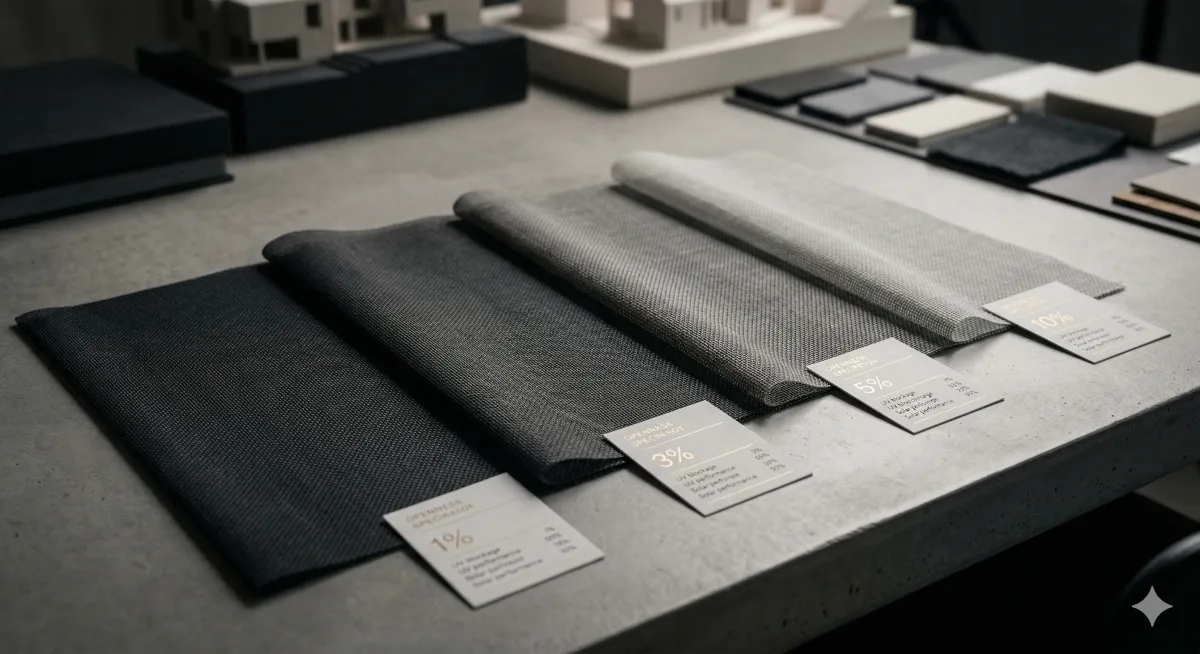
Openness factor (OF) is the percentage of open space in a fabric's weave relative to its total surface area. A fabric with a 3 percent openness factor has 3 percent of its surface area as open voids and 97 percent as solid material. This single number drives four interrelated performance characteristics: solar heat gain, visible light transmittance, outward visibility, and privacy.
The Openness Factor Spectrum and Its Performance Implications
Motorized screen fabrics are commercially available across a range from less than 1 percent openness to 14 percent or greater. The following ranges define practical performance tiers for designer reference.
1 percent to 3 percent openness factor This range delivers maximum solar heat gain reduction and maximum privacy. Fabrics in this tier block 97 to 99 percent of direct solar radiation when deployed, producing the most significant reduction in cooling load. Outward visibility is limited to close-range viewing at acute angles; from normal seated positions inside the space, the view through a 1 percent fabric is significantly obscured. This range is appropriate for west-facing exposures with intense afternoon sun, for spaces where occupant privacy from adjacent properties or public areas is a primary design requirement, and for commercial applications such as restaurant dining rooms and hotel guest amenity spaces where visual enclosure is part of the design intent.
3 percent to 5 percent openness factor This is the most commonly specified range for residential exterior applications. Fabrics at 3 to 5 percent openness reduce solar heat gain substantially while maintaining reasonable outward visibility from normal interior positions. The view through is preserved with some diffusion: colors and shapes are visible but fine detail is reduced. This range provides effective insect screening, meaningful UV reduction, and comfortable glare control without creating the enclosed feeling of lower openness fabrics. It is appropriate for lanais, covered patios, and screened porches where the connection to the outdoor view is a design priority alongside solar and insect control.
5 percent to 10 percent openness factor At this range, solar heat gain reduction diminishes relative to lower openness fabrics, but visible light transmittance increases and outward visibility approaches nearly unobstructed. Fabrics in the 5 to 10 percent range are specified primarily for applications where insect control and light filtering are the primary design goals, rather than maximum solar management. They are appropriate for shaded north-facing elevations, for spaces where interior light levels are critical, and for applications where the designer has determined that the project's sun exposure does not require the more aggressive solar management of tighter weaves.
Above 10 percent openness factor Fabrics above 10 percent openness provide minimal solar heat gain reduction and limited privacy. Their application is largely confined to situations where insect screening with maximum light transmission is the primary objective. These fabrics should not be specified in applications where the client's primary complaint is heat or glare.
Openness Factor Is Not the Same as Solar Transmittance
This distinction is critical for designers who reference ASHRAE or energy modeling data. Openness factor describes the physical geometry of the weave. Solar transmittance describes the actual fraction of incident solar radiation that passes through the deployed fabric, accounting for both the open voids and the partial solar transmission through the solid yarn material itself.
A fabric with a 3 percent openness factor does not necessarily have a 3 percent solar transmittance. The yarn material absorbs and reflects solar radiation, so the effective solar transmittance of a typical PVC-coated polyester fabric at 3 percent openness is typically in the range of 3 to 8 percent, depending on yarn color and composition. Dark-colored yarns absorb more solar radiation (reducing transmittance but increasing surface temperature). Light-colored yarns reflect more solar radiation (reducing surface temperature and reducing glare on overcast days but potentially reducing the screen's effectiveness as a thermal barrier on the interior side).
For projects where energy modeling is required, designers should obtain the fabric's solar transmittance (Tsol), solar reflectance (Rsol), and visible light transmittance (Tvis) values from the manufacturer's published data sheet rather than deriving them from openness factor alone. These values feed directly into ASHRAE 90.1 solar heat gain coefficient (SHGC) calculations and into the window assembly performance modeling used in energy compliance documentation.
UV Performance: What the Ratings Mean and Why They Matter to Designers
Ultraviolet radiation is responsible for the majority of light-induced degradation in interior furnishings, flooring, and textiles. Designers who specify high-quality finishes and materials for interior spaces adjacent to exterior glazing or large openings are specifying a system that is performing against UV degradation from day one. Motorized screen fabric selection is one of the most effective tools for managing that degradation without altering the visual character of the space.
UV Transmittance and UPF Rating
Fabric UV performance is expressed in two ways depending on the context.
UV transmittance is the fraction of ultraviolet radiation (typically measured across the 300 to 400 nanometer spectrum) that passes through the fabric. A fabric with a UV transmittance of 5 percent passes 5 percent of incident UV radiation. Most quality motorized screen fabrics at 3 percent openness or below achieve UV transmittances in the range of 3 to 10 percent, providing 90 to 97 percent UV blockage.
UPF (Ultraviolet Protection Factor) is the rating system borrowed from textile and apparel standards and increasingly applied to architectural screen fabrics. A UPF rating of 50 indicates that the fabric blocks 98 percent of UV radiation. The Skin Cancer Foundation recommends a minimum UPF 30 for protective textiles; many motorized screen fabrics exceed UPF 50 at openness factors of 5 percent and below.
For designer specification purposes, the relevant data point is UV transmittance from the manufacturer's published product data, which directly describes the fabric's performance against interior material degradation rather than against skin exposure. When specifying for spaces with high-value furnishings, hardwood or stone flooring, artwork, or textiles with known UV sensitivity, designers should select fabrics with UV transmittance values at or below 5 percent.
The Relationship Between Fabric Color and UV Performance
Color affects UV performance in ways that are not always intuitive. Darker-colored fabrics typically achieve lower UV transmittance than lighter fabrics of the same weave density, because the pigmentation in the yarn absorbs UV radiation that would otherwise pass through. However, dark fabrics also absorb more total solar radiation, which increases the surface temperature of the deployed fabric and can result in radiant heat transfer to the interior space in high-sun conditions.
Light-colored fabrics reflect more solar radiation, maintaining lower surface temperatures, but may achieve slightly higher UV transmittance values than equivalent dark fabrics. For applications where both UV protection and thermal comfort are priorities, mid-range neutral tones (warm grays, taupes, bronze tones) typically balance both properties most effectively.
White and near-white fabrics present a specific consideration: they reflect solar radiation effectively from the exterior and maintain excellent outward visibility, but some white fabric formulations achieve UV transmittance values higher than equivalent neutral-tone fabrics. Designers should confirm UV transmittance data from the manufacturer for any white or near-white fabric specification rather than assuming equivalence with darker options.
Specifying Screen Fabrics for Your Next Design Project?
One Track's technical resources include fabric data sheets with openness factor, UV transmittance, solar heat gain, and color specifications for use in professional submittals. Explore One Track's fabric library at onetrackscreens.com
Application-Specific Fabric Recommendations
The following guidance maps fabric selection criteria to the most common motorized screen application types encountered in residential and commercial design practice. These recommendations are starting points for the specification process; final selection should be validated against the manufacturer's published data for the specific product being specified.
Residential Lanai and Screened Porch: Florida and Gulf Coast
Primary design goals: Insect control, solar heat gain reduction, UV protection for interior furnishings, outward view preservation, aesthetics compatible with the interior design scheme.
Recommended openness factor range: 3 percent to 5 percent for standard residential applications; 1 percent to 3 percent for west-facing exposures or spaces with significant afternoon sun load.
Color guidance: Neutral mid-tones (charcoal, bronze, sand) maintain outward visibility most effectively because they reduce glare contrast between the bright exterior and the screen surface. Dark fabrics reduce glare more aggressively but decrease outward visibility in bright midday conditions. Lighter tones are appropriate for north-facing applications where solar management is secondary to light transmission.
UV specification note: Specify a UV transmittance value at or below 5 percent for spaces containing wood flooring, upholstered furnishings, or artwork visible from the adjacent interior.
Commercial Restaurant and Hospitality: Outdoor Dining and Amenity Spaces
Primary design goals: Privacy and visual enclosure for dining experience, wind attenuation, insect control, rain protection, solar management without eliminating ambient daylight character.
Recommended openness factor range: 1 percent to 3 percent for maximum privacy and solar management in high-visibility commercial environments. Consider 3 percent to 5 percent for applications where daytime ambience depends on natural light quality.
Color guidance: Dark neutrals (charcoal, deep bronze, slate) are appropriate for commercial applications where visual enclosure and sophistication of the design aesthetic are priorities. They also minimize the visual presence of the screen system when deployed, maintaining the designed character of the space rather than drawing attention to the screen hardware.
Fire rating note: Commercial applications may require screen fabrics that meet NFPA 701 flame spread requirements. Designers should verify NFPA 701 compliance with the manufacturer before specifying any fabric for commercial occupancy. Most quality commercial screen fabrics carry NFPA 701 test documentation; confirm that the specific product specification includes this compliance data.
Commercial Office and Mixed-Use: Glazed Facades and Conference Rooms
Primary design goals: Glare reduction at workstations, solar heat gain management aligned with ASHRAE 90.1 energy compliance targets, outward view preservation, coordination with interior roller shade specifications.
Recommended openness factor range: 3 percent to 5 percent for exterior solar screens deployed at the glazed building skin. The exterior deployment position provides significantly greater solar heat gain reduction per unit of openness factor than equivalent interior shades because the fabric intercepts solar radiation before it enters the glazed assembly.
SHGC integration note: When motorized exterior screens are part of an energy compliance calculation, the combined SHGC of the glazing assembly plus the deployed exterior screen must be calculated using the fabric's published solar optical properties. The Lawrence Berkeley National Laboratory's Window software supports exterior shading layer modeling for ASHRAE compliance documentation.
Coordination note: Exterior motorized screen specifications must coordinate with any interior roller shade or blind specifications to avoid specifying redundant solar control that the energy model has not accounted for. The exterior screen provides the primary solar management function; interior shades serve a supplementary glare control role.
Residential Privacy Screen: Pool Deck and Outdoor Shower Applications
Primary design goals: Visual privacy from adjacent properties or public areas, wind attenuation, UV protection, minimal visual impact on the property when screens are retracted.
Recommended openness factor range: 1 percent to 3 percent. Privacy applications require the minimum openness factor consistent with adequate ventilation. At 1 percent openness, the deployed screen provides near-complete visual privacy from exterior positions while maintaining airflow through the weave.
Color guidance: For privacy applications, fabric color selection should consider the view from the exterior as well as the view from the interior. Dark fabrics viewed from outside appear more visually solid, reinforcing the privacy function. Lighter fabrics appear less visually imposing from the exterior but may provide less privacy in backlit conditions (when interior lighting at night makes occupants visible through even low-openness fabrics). Designers should discuss day/night privacy requirements with the client before finalizing the color specification.
Fabric Material Types and Their Performance Characteristics
Motorized screen fabrics are manufactured from two primary material categories, each with distinct performance profiles relevant to specification decisions.
PVC-Coated Polyester
PVC-coated polyester is the most widely used material for solar screen and exterior shade applications. The construction consists of a polyester yarn core coated with a PVC (polyvinyl chloride) compound that is extruded around the yarn before the fabric is woven. The PVC coating provides UV stabilization, color consistency, dimensional stability, and resistance to moisture, mold, and coastal salt environments.
Key performance characteristics for specification:
Tensile strength: typically 300 to 700 N/50mm in the warp direction depending on yarn size and weave density
UV stability: PVC-coated fabrics formulated for exterior use include UV stabilizers in the coating compound; look for manufacturer data confirming UV resistance to a minimum of 500 to 1,000 kLy (kilolangley) solar radiation exposure, the equivalent of 10 to 20 years of average sun exposure in a southern US climate
Dimensional stability: PVC coating minimizes the elongation and shrinkage that uncoated polyester fabrics exhibit under humidity and temperature cycling, which is critical for maintaining even tension across wide-span motorized screen applications
Cleaning: PVC-coated fabrics are cleanable with mild soap and water; avoid petroleum-based solvents, which degrade PVC compounds
Fiberglass-Core Fabrics
Fiberglass-core fabrics use a woven fiberglass yarn as the structural element, with a vinyl or acrylic coating for UV protection and dimensional stability. Fiberglass fabrics offer higher dimensional stability than polyester fabrics, particularly in wide-span applications, because fiberglass yarn has minimal elongation under tension. They are also non-combustible at the fiber level, which contributes to favorable fire performance characteristics.
Key performance characteristics for specification:
Dimensional stability: superior to PVC-coated polyester for spans exceeding 12 to 14 feet; preferred for large commercial applications
Fire performance: fiberglass core is inherently non-combustible; coating compounds vary in fire rating; confirm NFPA 701 compliance documentation for commercial specifications
Weight: fiberglass fabrics are typically heavier per unit area than equivalent PVC-coated polyester fabrics; confirm that the specified motor's torque rating is appropriate for the fabric weight and screen dimensions
Specialty Fabrics: Aramid and High-Tenacity Blends
For hurricane-rated motorized screen applications in the HVHZ or for projects requiring Max Force Hurricane Screens performance levels, the fabric specification moves beyond standard solar screen materials into engineered structural textiles. Aramid-fiber and aramid-blend fabrics provide the debris impact resistance required for ASTM E1886/E1996 and Miami-Dade TAS 201 certification. These fabrics are not interchangeable with solar screen fabrics and are specified as part of a complete certified system, not as an independent fabric selection.
Compiling the Fabric Specification for the Submittal Package
A complete fabric specification for a motorized screen project submittal includes the following data, all of which should be obtainable from the manufacturer's published product data sheet:
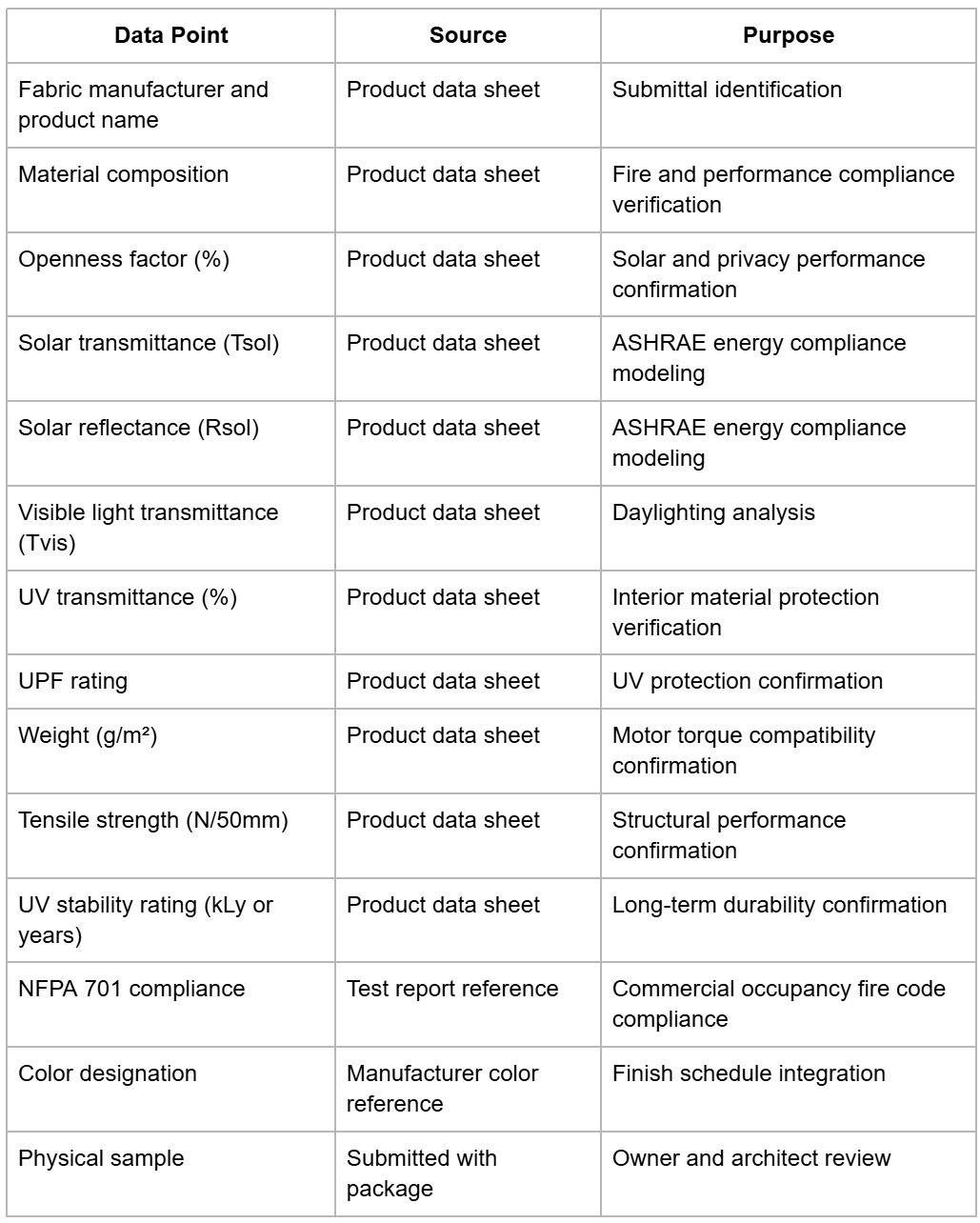
The Next Gen Screens blog series provides additional technical reference for designers coordinating fabric specifications with motor torque requirements, wind load ratings, and architectural drawing integration across the full 12-blog series.
Conclusion: Fabric Selection Is a Technical Decision With Aesthetic Consequences
The openness factor, UV transmittance, material composition, and color of a motorized screen fabric are not finishing touches applied after the structural and mechanical decisions are made. They are the primary performance levers that determine whether the installed screen system achieves the client's comfort, energy, privacy, and aesthetic goals.
Designers who engage with the technical data behind fabric selection produce specifications that perform as intended, from the first day of occupancy through the full service life of the system. The specification process begins with a clear understanding of the application's priorities, continues through a systematic review of manufacturer data, and concludes with a complete, documented submittal package that confirms every performance parameter has been verified before the fabric goes to the fabricator.
Ready to build your fabric specification? The technical library at Next Gen Screens provides data-backed fabric resources organized for design professionals. Access the full resource library at nextgenscreens.com.