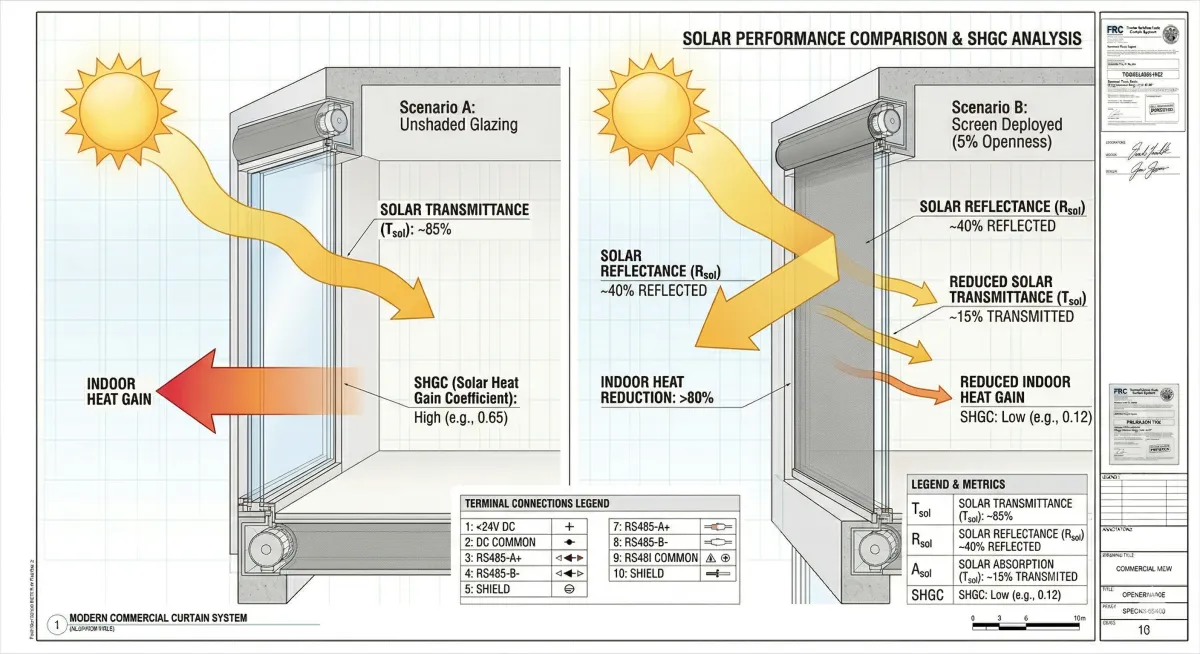
Solar Heat Gain and Shading Coefficients: How Motorized Screens Perform Against ASHRAE 90.1 Standards
Why Solar Performance Data Belongs in the Fabric Specification
A designer who selects a motorized screen fabric based on color, openness factor, and aesthetic compatibility with the interior design scheme has completed approximately 60 percent of the specification work. The remaining 40 percent is the thermal performance data: how the selected fabric's solar optical properties translate into measurable solar heat gain reduction, how that reduction compares to the project's fenestration compliance requirements under ASHRAE 90.1, and whether the thermal performance of the specified fabric actually achieves the interior comfort and energy management objectives that motivated the screen specification in the first place.
This gap between aesthetic specification and thermal specification is not a minor oversight. A fabric specified with a 5 percent openness factor in a warm neutral tone may achieve a solar transmittance (Tsol) of 6 to 8 percent or it may achieve a Tsol of 12 to 15 percent depending on the yarn material, coating chemistry, and weave geometry. Those two fabrics look nearly identical at the design development phase. They perform very differently in July at 2 PM on a west-facing facade. And they produce very different numbers in the project's energy compliance model.
Designers who understand how to read fabric solar optical data, how to apply it to fenestration assembly SHGC calculations, and how exterior screen position compares to interior position in terms of thermal effectiveness produce specifications that deliver the thermal performance the project requires. The fabric library at Next Gen Screens provides product-specific solar optical data formatted for designer and energy modeler use.
The Physics of Exterior Solar Screening: Why Position Matters
Before examining the data, the fundamental thermal physics of exterior versus interior shading must be established. This distinction is not a marketing claim; it is a direct consequence of where in the heat transfer sequence the shading device intercepts solar radiation.
The Exterior Interception Advantage
Solar radiation incident on a building's glazing follows a three-part fate: a fraction is transmitted directly through the glazing into the interior (the transmitted component), a fraction is reflected back to the exterior (the reflected component), and a fraction is absorbed by the glazing material and re-radiated inward as long-wave thermal radiation (the absorbed and re-radiated component). The solar heat gain coefficient (SHGC) of a glazing assembly is the sum of the directly transmitted fraction plus the inward-flowing fraction of the absorbed component, expressed as a dimensionless number between 0 and 1.
When an interior blind or shade is deployed, it intercepts the solar radiation after it has already passed through the glazing. The direct transmittance is blocked, but the glazing's absorbed heat continues to re-radiate inward regardless of the interior shade's position. The interior shade reduces the transmitted component of SHGC but has essentially no effect on the absorbed-and-re-radiated component. Interior shading devices also absorb solar radiation themselves and re-radiate it into the interior space, adding to the internal heat gain.
When an exterior screen is deployed, it intercepts solar radiation before it reaches the glazing entirely. The screen reduces the irradiance incident on the glazing, which proportionally reduces all three components of heat transfer through the glazing: direct transmittance, absorbed-and-re-radiated heat, and any secondary reflections from the glazing interior surface. The U.S. Department of Energy's Building Technologies Office has documented that exterior shading devices can reduce solar heat gain through glazing by 65 to 77 percent on south-facing walls and up to 77 percent on west-facing walls under peak summer conditions, compared to 25 to 40 percent reduction achievable with equivalent interior shading devices.
This performance advantage is the physical basis for the ASHRAE 90.1 preference for exterior dynamic shading devices in fenestration compliance calculations. An exterior screen with a 5 percent openness factor is not simply a lower-SHGC window. It is a dynamic shading device that intercepts solar radiation at the most thermally effective point in the heat transfer sequence.
Reading Fabric Solar Optical Data: The Three Values Every Designer Needs
The full solar optical characterization of a motorized screen fabric requires three values, all of which should be available in the manufacturer's published product data sheet and all of which are measured per NFRC 100: Procedure for Determining Fenestration Product U-factors or equivalent ASTM optical measurement standards.
Solar Transmittance (Tsol)
Solar transmittance is the fraction of incident solar radiation (300 to 2,500 nanometer spectrum) that passes directly through the fabric. It is the most critical thermal performance value for fabric selection and the one most frequently confused with openness factor. As discussed in Blog 3 of this series, openness factor describes the physical geometry of the weave, while Tsol describes the actual optical performance of the deployed fabric including partial transmission through the solid yarn material.
A 5 percent openness factor fabric with a PVC-coated polyester yarn in a dark charcoal color will typically achieve a Tsol in the range of 4 to 7 percent. The same openness factor in a white or near-white color will typically achieve a Tsol in the range of 8 to 14 percent, because white yarn reflects more solar radiation back to the exterior (increasing Rsol) while simultaneously allowing more to pass through the yarn itself (increasing Tsol). This counterintuitive relationship between light color and higher solar transmittance is one of the most important fabric performance principles for designers to understand.
For energy compliance purposes, Tsol is the primary input value. The designer must obtain the specific published Tsol for the exact fabric being specified, not an estimate based on openness factor.
Solar Reflectance (Rsol)
Solar reflectance is the fraction of incident solar radiation that the deployed fabric reflects back to the exterior. Together with Tsol and the fabric's solar absorptance (Asol = 1 - Tsol - Rsol), Rsol completes the solar energy balance at the fabric surface.
High Rsol values are thermally favorable because reflected radiation returns to the exterior without contributing to building heat gain. White and near-white fabrics achieve higher Rsol values than dark fabrics of the same openness factor, which explains why light-colored fabrics are specified for applications where minimizing total heat gain (rather than maximizing privacy or view control) is the primary design objective.
For energy modelers using whole-building simulation tools such as EnergyPlus or eQUEST, Rsol is a required input alongside Tsol and Tvis for accurate dynamic shading device modeling under ASHRAE 90.1.
Visible Light Transmittance (Tvis)
Visible light transmittance is the fraction of visible light (380 to 780 nanometer spectrum) that passes through the deployed fabric. Tvis determines the quality and quantity of natural daylight that enters the space when the screen is deployed, which directly affects occupant perception of the screened environment and is a relevant input for daylight analysis under LEED v4.1 Credit: Daylight and WELL Building Standard v2 Feature L07.
Tvis is typically higher than Tsol for the same fabric because the human eye is most sensitive to the visible spectrum (green and yellow wavelengths) where fabrics tend to transmit more effectively than in the broader solar spectrum including near-infrared. A fabric with a Tsol of 6 percent may have a Tvis of 9 to 12 percent, meaning the space appears lighter to occupants than the Tsol value alone would suggest.
For designers specifying screens for hospitality, office, and residential applications where preserving the quality of natural light is a design priority alongside solar control, Tvis is the selection criterion that distinguishes fabrics of similar Tsol and openness factor.
Specifying Screen Fabrics for Energy Performance on Your Next Project?
One Track's fabric documentation includes Tsol, Rsol, and Tvis values for all specifications, formatted for direct input into ASHRAE 90.1 compliance calculations and energy models. Access One Track's fabric performance library at onetrackscreens.com
Applying Fabric Data to the ASHRAE 90.1 Compliance Calculation
For commercial projects subject to ASHRAE 90.1-2022 energy compliance, exterior motorized screens can contribute to meeting the fenestration SHGC requirements of ASHRAE 90.1 Table 5.5-5 when the screens are specified as dynamic exterior shading devices and when their solar optical properties are properly applied in the compliance calculation.
The Prescriptive Path Calculation
Under the ASHRAE 90.1 prescriptive compliance path, the effective SHGC of a fenestration assembly with an exterior dynamic shading device deployed is calculated by multiplying the glazing assembly's published SHGC by the screen fabric's Tsol:
SHGC_effective = SHGC_glazing × Tsol_fabric
For example: a commercial glazing assembly with a published SHGC of 0.40 combined with an exterior screen fabric with a Tsol of 0.06 (6 percent) produces an effective SHGC of:
SHGC_effective = 0.40 × 0.06 = 0.024
This effective SHGC of 0.024 represents a 94 percent reduction in solar heat gain compared to the unshaded glazing assembly and substantially exceeds the ASHRAE 90.1 Climate Zone 1 and 2 SHGC requirements for vertical fenestration (typically 0.25 or below), providing significant compliance margin.
Critical limitation of this calculation: The prescriptive path effective SHGC applies only when the screen is deployed. For dynamic shading devices, ASHRAE 90.1 requires that the sequence of operations for automatic deployment be documented and that the deployment logic be confirmed to operate the screen when the solar conditions that drive the compliance calculation occur. A screen specified for energy compliance that is manually operated and rarely deployed does not achieve the modeled compliance performance in practice.
Designers specifying exterior motorized screens for ASHRAE 90.1 compliance contribution must coordinate with the project's building automation sequence of operations documentation (reference Blog 6 of this series) to confirm that the deployment logic matches the compliance assumptions. This coordination must occur during design development, not after permit submission.
Climate Zone Sensitivity
ASHRAE 90.1 Table 5.5-5 prescribes different SHGC requirements for each of the eight climate zones. Climate zones relevant to Florida, Gulf Coast, and Southeast US motorized screen markets are:
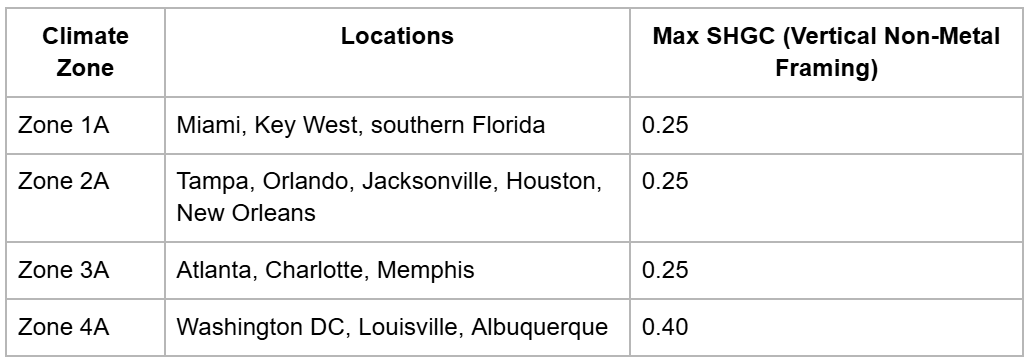
The Zone 1A and 2A maximum SHGC of 0.25 is the most demanding requirement and the most frequently encountered in the Florida and Gulf Coast markets where motorized screens are most commonly specified. A glazing assembly with SHGC = 0.40 (a common commercial low-e glazing specification) does not meet the Zone 1A or 2A requirements without additional shading. Adding an exterior screen fabric with Tsol = 0.06 reduces the effective SHGC to 0.024, meeting the requirement with significant margin.
This compliance pathway is particularly valuable for projects where the architectural design specifies high-SHGC glazing for aesthetic reasons (clear glass, minimal tint) and the energy compliance engineer needs a pathway to meet Zone 1A or 2A SHGC requirements without redesigning the glazing system.
Fabric Selection Matrix for Thermal Performance by Application
The following selection matrix maps fabric solar optical performance characteristics to application-specific thermal design objectives. Values shown are representative ranges for quality commercial-grade PVC-coated polyester fabrics; specific values must be confirmed from the manufacturer's published product data sheet for the exact fabric being specified.
Application Type 1: High-Solar-Load West and South Facades, Florida and Gulf Coast
Design objective: Maximum solar heat gain reduction while preserving outward visibility from occupied interior spaces.
Recommended performance profile:
Openness factor: 3% to 5%
Tsol target: 0.05 to 0.08 (5% to 8%)
Rsol target: 0.50 to 0.65 (50% to 65%)
Tvis target: 0.08 to 0.12 (8% to 12%)
Color guidance: Mid-tone neutrals (charcoal, bronze, slate). Dark fabrics achieve lower Tsol values, maximizing solar heat gain reduction. Avoid white or near-white fabrics on high-solar-load facades where thermal performance is the primary specification criterion, as these fabrics achieve higher Tsol values despite their high Rsol, because more radiation passes through the yarn structure than is reflected.
ASHRAE calculation example: Glazing SHGC = 0.40; Tsol = 0.06; effective SHGC = 0.024. Meets Zone 1A and 2A requirements with 90% margin.
Application Type 2: Residential Lanai and Screened Porch, Solar Control Plus Privacy
Design objective: Balanced solar heat gain reduction, UV protection for interior furnishings, and visual privacy without eliminating the connection to the outdoor environment.
Recommended performance profile:
Openness factor: 3% to 5%
Tsol target: 0.05 to 0.10 (5% to 10%)
Tvis target: 0.08 to 0.15 (8% to 15%)
UV transmittance: less than 5%
Color guidance: Warm neutrals (sand, taupe, bronze) provide the best balance of solar control and outward visibility. For lanai applications where the outdoor view is a significant design element, specify fabrics at the higher end of the Tvis range (0.12 to 0.15) within the 3% to 5% openness range.
Application Type 3: Commercial Office Glazed Facades, Glare Control Plus Daylighting
Design objective: Glare reduction at workstations, solar heat gain management for ASHRAE 90.1 compliance, and preservation of daylighting quality for occupant wellbeing and LEED credit eligibility.
Recommended performance profile:
Openness factor: 3% to 5%
Tsol target: 0.04 to 0.08 (4% to 8%)
Tvis target: 0.10 to 0.18 (10% to 18%)
High Tvis-to-Tsol ratio: fabrics that achieve a Tvis/Tsol ratio greater than 1.5 provide more visible light relative to solar heat gain, maximizing daylighting quality while maintaining solar control
Design note: For LEED v4.1 Daylight Credit compliance, the spatial daylight autonomy (sDA) calculation requires that the space receive at least 300 lux from daylight for at least 50 percent of annual occupied hours. An exterior screen with a Tvis of 0.10 deployed continuously may reduce spatial daylight autonomy below the LEED threshold. Confirm with the project's daylight modeler whether a dynamic deployment schedule (screens deploy only during direct sun exposure) rather than continuous deployment is required to maintain LEED credit compliance while achieving ASHRAE 90.1 SHGC compliance.
Application Type 4: Hospitality and Restaurant, Ambience Plus Solar Management
Design objective: Visual enclosure for privacy and ambience, solar heat gain reduction for occupant comfort, and sufficient daylight transmission to maintain the quality of the interior lighting environment during daytime service.
Recommended performance profile:
Openness factor: 1% to 3% for maximum visual enclosure
Tsol target: 0.02 to 0.05 (2% to 5%)
Tvis target: 0.05 to 0.10 (5% to 10%)
Color guidance: Dark neutrals (charcoal, deep slate, dark bronze) maximize visual privacy from exterior positions and achieve the lowest Tsol values, providing maximum solar protection for outdoor dining environments where the occupied space is exterior to the building skin.
Interior vs. Exterior Position: Quantifying the Thermal Performance Difference
For projects where the designer is evaluating whether to specify exterior motorized screens or interior motorized shades for solar control, the thermal performance difference between the two positions is substantial and quantifiable.
A Direct Comparison Using the Same Fabric
Consider a 5% openness factor charcoal PVC-coated polyester fabric with the following published properties: Tsol = 0.06, Rsol = 0.60, Asol = 0.34.
Exterior position (motorized screen): The screen intercepts solar radiation before it reaches the glazing. The effective SHGC of the glazed assembly with the screen deployed is approximately:
SHGC_effective ≈ SHGC_glazing × Tsol_screen = 0.40 × 0.06 = 0.024
The fabric's reflected component (60%) is directed back to the exterior, contributing zero heat gain to the building interior. The fabric's absorbed component (34%) heats the fabric surface itself, which is located in the exterior environment where natural convection and wind carry the absorbed heat away from the building envelope.
Interior position (motorized shade, same fabric): The interior shade intercepts solar radiation after it has passed through the glazing. The glazing has already transmitted its direct transmittance component and begun re-radiating its absorbed heat inward. The interior shade blocks the direct transmittance but cannot remove the heat already absorbed by the glazing. Additionally, the shade itself absorbs 34% of the incident radiation that passes through the glazing and re-radiates it into the interior space. The effective SHGC reduction from interior shading with this fabric is typically 40% to 55% compared to the unshaded condition, producing an effective SHGC in the range of 0.18 to 0.24 for the same glazing assembly that achieved 0.024 with the exterior screen.
This comparison illustrates the thermal physics directly: the exterior screen achieves roughly 10 times better solar heat gain reduction than an equivalent interior shade. For projects in ASHRAE 90.1 Climate Zones 1A and 2A where the maximum SHGC is 0.25, the interior shade with this glazing assembly barely achieves compliance, while the exterior screen exceeds the requirement by a factor of ten.
Connecting Fabric Performance to Interior Comfort: The Designer's Perspective
The thermal data described in this guide has direct consequences for occupant comfort that translate into the design outcomes designers are responsible for delivering. A west-facing conference room with full-height glazing and a SHGC = 0.40 glazing system generates a peak afternoon cooling load that elevates mean radiant temperature in the room regardless of air-side HVAC capacity. The occupants feel hot because radiant heat transfer from the glass surface and from objects heated by transmitted solar radiation contributes to their thermal sensation independent of air temperature.
Specifying an exterior motorized screen with Tsol = 0.06 on that west-facing facade does not simply reduce the energy compliance number. It reduces the peak radiant heat load in the space by approximately 85 percent compared to the unshaded condition. Occupants seated near the glazing experience measurably lower thermal discomfort. The HVAC system operates at lower capacity during peak afternoon hours. Glare that forces occupants to reposition workstations or close interior blinds is eliminated. The design intent of a light-filled, visually connected workspace is preserved rather than compromised by the occupant's response to thermal discomfort.
These outcomes are achievable only when the fabric is specified with both aesthetic and thermal performance criteria. The fabric that looks right and performs right is the specification that delivers the design intent through occupation, not just at project completion photography.
For hurricane-rated applications where the screen must serve both solar control and storm protection functions, the fabric selection must meet performance criteria across both domains simultaneously. Max Force Hurricane Screens provides systems where the aramid-fiber structural fabric carries solar optical data for energy compliance alongside its structural certification data, enabling designers to specify a single-fabric solution that meets both the thermal and the structural performance requirements of the project.
The Next Gen Screens blog series provides complementary reference material for designers coordinating fabric specifications with the broader project team, including the fabric selection framework by openness factor and UV performance (Blog 3), commercial ASHRAE 90.1 integration requirements for architects (Blog 6), and solar performance documentation for the ASHRAE compliance submittal package.
Conclusion: Fabric Thermal Performance Is a Specification Deliverable, Not a Modeler's Problem
The solar optical properties of the specified screen fabric are not the energy modeler's problem to discover during compliance analysis. They are the designer's deliverable at the fabric specification phase. When the designer specifies a fabric with published Tsol, Rsol, and Tvis values and communicates those values to the project's energy compliance engineer, the compliance calculation proceeds on accurate data. When the designer specifies a fabric by color and openness factor without providing optical data, the energy modeler must either assume values or request data that should have been part of the specification package.
The designer who delivers complete solar optical data with the fabric specification produces a project where the compliance calculation is accurate, the interior comfort outcomes are predictable, and the HVAC engineer's cooling load analysis reflects the actual thermal performance of the installed fenestration assembly. That is not a technical detail. That is the performance specification.
Ready to build your fabric specification with complete solar optical data? The designer resource library at Next Gen Screens provides fabric performance data formatted for energy compliance and project documentation. Access the full library at nextgenscreens.com.