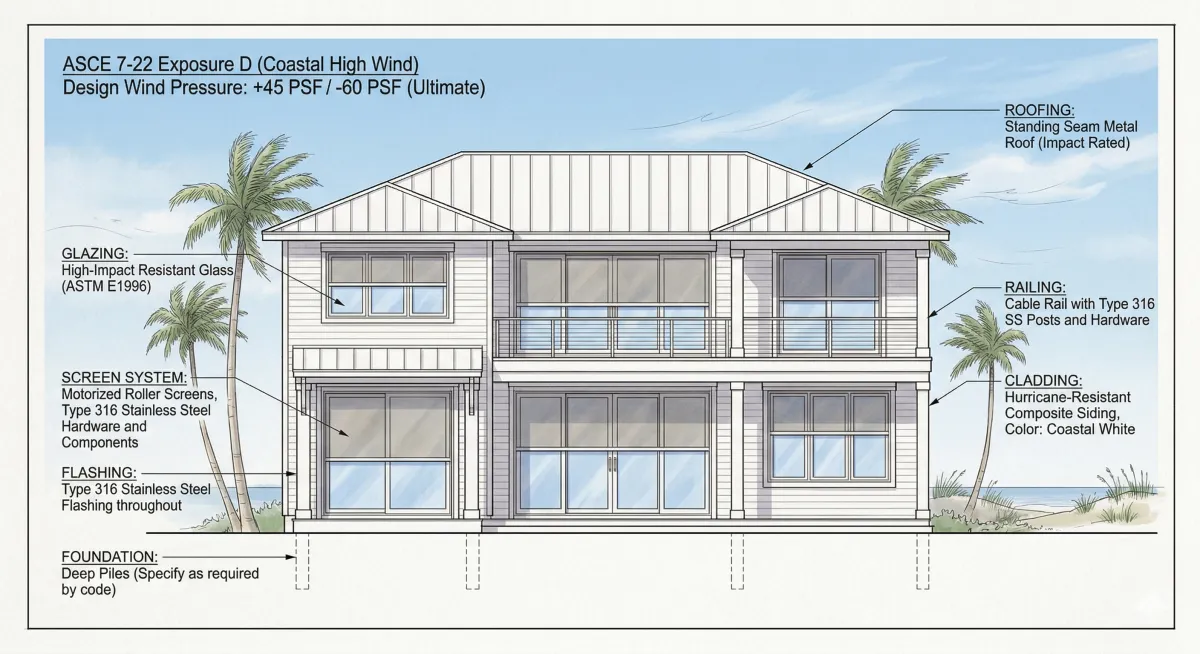
Motorized Screen Specifications for Coastal and High-Wind Regions: HVHZ, Miami-Dade, and ASCE 7 Compliance
Why Coastal Specification Is a Distinct Discipline, Not a Higher-Wind Version of Standard Practice
An architect specifying motorized screens for a coastal project in Exposure Category D cannot simply take a standard residential specification and increase the design wind pressure. The coastal and high-wind-zone specification environment differs from inland practice in five fundamental ways, each of which requires specific knowledge and deliberate decision-making at the design phase.
The design wind pressures are substantially higher, with corner zone negative pressures in Exposure D exceeding 80 psf on tall buildings in the highest coastal wind speed zones. The certification requirements are jurisdictionally layered, with HVHZ projects in Miami-Dade and Broward Counties requiring Miami-Dade NOA certification that supersedes and exceeds the statewide Florida Product Approval system. The impact certification standard in the HVHZ requires the screen to resist a nine-pound two-by-four at 50 feet per second followed by 9,000 cycles of cyclic pressure at 1.5 times the design pressure, a test protocol that a significant portion of the products on the national market cannot pass. The material specifications must account for a salt-air environment that will attack standard hardware, coating, and gasket materials in ways that are invisible at installation but structurally consequential within 5 years. And the coordination requirements, particularly around HVHZ NOA installation details that are incorporated by code reference, are more stringent than anything the standard Product Approval system requires.
This guide addresses all five dimensions. The technical resource library at Next Gen Screens provides product-specific coastal specification data, NOA documentation, and material certifications to support the architect's specification process in these demanding environments.
ASCE 7-22 Exposure Category D: What Changes in Coastal Design Wind Pressure
ASCE 7-22 defines Exposure Category D as flat, unobstructed areas exposed to wind flowing over open water for a distance of at least 5,000 feet. This category encompasses the immediate shoreline, barrier islands, and properties within approximately one mile of the coastal mean high waterline in areas without significant upwind obstruction. Most coastal residential and resort construction in Florida and the Gulf Coast falls within Exposure D or transitions from Exposure D to Exposure C at distances between one-quarter and one mile from the water.
The Pressure Magnitude Difference Between Exposure Categories
The velocity pressure (qh) that drives design wind pressure calculations increases with exposure category because surface roughness in Exposure D is lower, allowing the wind to maintain higher speeds closer to grade. The exposure factor (Kz or Kh) that adjusts velocity pressure for terrain roughness is significantly higher in Exposure D than in Exposure B or C:
At 33 feet above grade:
Exposure B: Kz = 0.70
Exposure C: Kz = 0.85
Exposure D: Kz = 1.03
This means that at the same basic wind speed and building height, the velocity pressure in Exposure D is approximately 47 percent higher than in Exposure B and 21 percent higher than in Exposure C. For a coastal project with a basic wind speed of 160 mph (a common value in central coastal Florida), the design wind pressure on a corner zone (Zone 5) screen at building mid-height in Exposure D will typically exceed 65 to 80 psf negative, compared to 45 to 55 psf negative for the same building in Exposure C.
Corner Zone Pressure Amplification
ASCE 7-22 Chapter 30 assigns higher design wind pressures to screen and glazing assemblies located in the corner zones (Zone 5) of a building's facade. In coastal Exposure D conditions, the corner zone negative pressure amplification is particularly significant because the combination of high basic wind speed, high Kz, and the Zone 5 pressure coefficient produces the highest design pressures that any motorized screen specification will encounter outside a laboratory wind tunnel test.
For a coastal Florida project with basic wind speed V = 160 mph, Exposure D, building height 30 feet, and the screen located in Zone 5:
The Zone 5 design wind pressure (negative) will typically be in the range of 70 to 90 psf depending on the building's enclosure classification and the exact dimensions used in the calculation. Architects must confirm this calculation using the ATC Hazards by Location tool for the project's specific address and the building's actual roof height, rather than using tabulated approximate values.
Confirming That the Specified Product's NOA or Product Approval Covers the Calculated Design Pressure
The fundamental specification task that follows the design pressure calculation is confirming that the motorized screen system selected for the project carries a product approval or NOA that certifies performance at or above the calculated design pressure for the applicable building zone (Zone 4 field, Zone 5 corner). This verification must be completed for every screen location on the project, not just for the worst-case corner location, because the design pressures vary across the building facade and different screen locations may require different levels of certification.
Where the calculated design pressure for a corner zone location exceeds the maximum certified pressure in any available product approval, the architect must either: redesign the screen location to move it out of the corner zone (if architecturally feasible), specify a custom-engineered screen assembly with a project-specific structural analysis stamped by a licensed structural engineer, or coordinate with the building official on an alternative means and methods approval.
HVHZ Specification Requirements: What the NOA Adds to the Standard Product Approval
As established in Blog 5 of this series, projects in Miami-Dade and Broward Counties fall within Florida's High-Velocity Hurricane Zone and require Miami-Dade County NOA certification rather than the statewide Florida Product Approval. For architects specifying motorized screens on coastal projects in these counties, the NOA introduces specification requirements that exceed the standard product approval in three significant areas.
NOA Testing Protocol: What TAS 203 Demands Beyond ASTM E1996
The ASTM E1886/E1996 testing sequence that governs statewide Florida Product Approvals subjects the screen to large missile impact followed by 4,500 cycles of alternating positive and negative pressure at the design pressure. The Miami-Dade TAS 203 protocol subjects the screen to the same large missile impact followed by 9,000 cycles at 1.5 times the design pressure. This represents twice the cycle count at a substantially higher pressure amplitude.
The significance for the architect is that products which pass ASTM testing are not automatically qualified for HVHZ installation. The additional fatigue loading in TAS 203 identifies products whose retention systems, track seals, and fabric edge connections degrade progressively under sustained cyclic loading even when they survive the initial missile impact. In the highest-risk coastal wind environments, the ability of a screen system to resist sustained multi-hour loading is not a secondary consideration; it is the primary certification criterion that distinguishes products capable of performing through a major hurricane from products that will fail before the storm's peak winds arrive.
For architects specifying motorized screens on HVHZ coastal projects, this means that the NOA certification number must be verified in the Miami-Dade product search portal before the product is specified, and the NOA must be current (not expired). An expired NOA is an uncertified product for HVHZ installation purposes, regardless of the product's physical characteristics.
NOA Installation Details as Code Documents
The Miami-Dade NOA includes installation detail drawings that are incorporated by reference into the approved certification. This is not an advisory reference; it is a code requirement. The installation performed on a permitted HVHZ project must match the NOA installation details for the applicable substrate and opening configuration. Deviations from the NOA installation details constitute a violation of the product certification and require a Miami-Dade Product Control Division variance request before any modified approach can be used.
For architects coordinating the design document set, this means that the NOA installation details are the controlling reference for header pocket dimensions, anchor type, anchor spacing, anchor embedment depth, and edge distance at each screen location. The architectural drawings must either replicate the NOA installation details or, where project-specific conditions require modification, reference the Miami-Dade variance process and include documentation of the approved modification.
NOA Annual Renewal and Specification Maintenance
Miami-Dade NOA certifications must be renewed annually by the manufacturer through the Miami-Dade Product Control Division, including ongoing third-party manufacturing facility inspections and market surveillance testing. An NOA that was valid when a project was designed may have expired or been modified by the time the project is permitted and constructed.
For projects with design-to-construction timelines exceeding 12 months, the architect must re-verify the NOA currency at the time of permit submission and again at the time of installation, not just at the time the product was initially selected. This is particularly important for projects where the NOA version at design may differ from the NOA version at construction, as NOA revisions may include changes to the approved installation details that affect the construction documents.
Specifying Motorized Screens for a Coastal or HVHZ Project?
Max Force Hurricane Screens provides systems with current Miami-Dade NOA certification, TAS 201/202/203 test documentation, and HVHZ-compliant installation details for coastal architectural specifications. Access Max Force's HVHZ documentation at maxforcescreens.com
Material Specifications for Coastal Salt-Air Environments
The coastal salt-air environment is the most aggressive long-term exposure condition that a motorized screen system will encounter in normal building service. Salt-laden moisture, UV radiation, and thermal cycling attack every material component of the system: the aluminum housing and track extrusions, the hardware fasteners and anchors, the motor, the wiring insulation, and the fabric coating.
Architects specifying motorized screens for coastal projects must review the material specifications for every system component and confirm that each material is rated for continuous coastal exposure. A system that meets the structural certification requirements but is assembled with materials that will fail in the coastal environment will not perform through the building's design service life, regardless of its NOA certification.
Aluminum Alloy and Finish Specification
The cassette housing, track extrusions, and mounting hardware are typically fabricated from extruded aluminum. For coastal applications, the aluminum alloy and surface finish specification must be appropriate for continuous salt-air exposure.
Alloy specification: 6063-T5 or 6061-T6 aluminum alloys are standard for architectural extrusions and provide adequate corrosion resistance in most coastal environments. 5052 or 5083 marine-grade aluminum alloys offer superior saltwater corrosion resistance for the most aggressive direct surf-zone exposures but are less commonly available in standard extrusion profiles. For projects within 300 feet of the surf zone, architects should confirm with the manufacturer that the alloy specification is marine-grade or that the standard alloy is treated for marine exposure.
Finish specification: Powder-coated finishes on aluminum provide UV resistance and surface protection, but powder coat alone is insufficient for coastal applications because coating defects, scratches, and screw penetrations expose the aluminum substrate to salt-air attack. The minimum finish specification for coastal motorized screen components is anodized aluminum at an anodize thickness of 0.7 mils (Class I, per AAMA 611) as a base coat beneath the powder coat, or a marine-grade PVDF (polyvinylidene fluoride) fluoropolymer coating in lieu of standard polyester powder coat. PVDF coatings (Kynar 500 or equivalent) provide substantially better chemical resistance and UV stability in coastal environments compared to standard thermoset polyester powder coat.
Verification requirement: The architect's specification should require the manufacturer to provide written confirmation that the aluminum alloy and finish specification for the system being supplied meets the coastal material requirements. Marketing language about "salt-air resistance" without alloy and finish data is not a specification-grade assurance.
Hardware and Fastener Specification
All field-applied fasteners, anchor bolts, mounting screws, and hardware components must be specified in Type 316 stainless steel for projects within 1,000 feet of saltwater, per the corrosion protection standards established in Blog 10 of this series. Type 304 stainless is not adequate for direct coastal exposure; its lower molybdenum content makes it susceptible to pitting corrosion in chloride-rich environments.
Zinc-plated hardware must not be specified for any exterior coastal application, regardless of the manufacturer's standard hardware package. Many motorized screen products are shipped with standard zinc-plated hardware as the default; the specification must explicitly require Type 316 stainless substitution and the architect must confirm at submittal review that the hardware delivered to the project matches the specification.
Motor and Electrical Component Specification
Motors installed in coastal environments must carry an IP55 or IP66 enclosure rating (per IEC 60529) to resist moisture and salt-laden air ingress into the motor housing and wiring connections. IP44, the minimum for protected interior applications, is insufficient for direct coastal exterior exposure.
Motor wiring connectors and junction boxes must be sealed against moisture ingress using silicone-sealed or potted connectors. Standard open-pin connectors that are common in interior motor installations will corrode within 2 to 3 years in direct coastal salt-air exposure, producing intermittent motor failures that are expensive to diagnose and repair after installation is complete.
The specification should require the manufacturer to confirm that all motor and electrical components supplied for the project meet the IP55 or IP66 standard and that all wiring connectors are sealed for marine-grade exposure.
Integrating Coastal Motorized Screen Specifications into the Construction Document Set
The coastal specification introduces documentation requirements that exceed the standard motorized screen specification scope. The following additional elements must be incorporated into the construction documents for coastal and HVHZ projects.
Coastal Material Specification Addendum to Division 10 28 00
The standard motorized screen specification section must be supplemented with coastal material requirements that explicitly state:
Aluminum alloy: minimum 6063-T5 with AAMA 611 Class I anodize base coat plus PVDF fluoropolymer topcoat, or as specified by the manufacturer for coastal marine-grade exposure
Hardware: all field-applied fasteners and anchors in Type 316 stainless steel per ASTM A276
Motor IP rating: IP55 minimum, IP66 for direct rain exposure
Motor wiring connectors: silicone-sealed or potted for marine-grade exposure
Product certification: Miami-Dade NOA for HVHZ projects; Florida Product Approval with design pressure rating confirmed for Exposure D design pressures for non-HVHZ coastal projects
These requirements must appear in the specification section, not merely in the drawings or as verbal instructions to the installer. A specification section that references only the NOA number without specifying material requirements leaves the coastal durability specification entirely to the manufacturer's standard product and the installer's field judgment.
Coastal Design Wind Pressure Table in the Drawings
For projects with multiple screen locations at different building heights and different distance from building corners, a design wind pressure table should appear in the architectural or structural drawing set that lists:
Basic wind speed (V) from ASCE 7-22 for the project site
Exposure Category (D for coastal projects within the applicable distance from the shoreline)
Velocity pressure (qh) at mean roof height
Zone 4 (field) design wind pressure: positive and negative psf
Zone 5 (corner) design wind pressure: positive and negative psf
The FL approval number or NOA number of the specified screen system
Confirmation that the system's certified design pressure equals or exceeds the Zone 5 design wind pressure
This table, signed and sealed by the architect or structural engineer of record, provides the building official with the certification path verification needed for permit review and establishes the design basis of record for the screen attachment.
NOA Version Control in the Specification
The specification section must include a note directing the contractor to verify that the NOA number and version at the time of product order and at the time of installation match the NOA number referenced in the specification. Where the NOA has been renewed since the project was designed and the renewal NOA includes changes to the installation details, the contractor must notify the architect before proceeding, and the construction documents must be updated to reflect the current NOA installation details.
Version control of the NOA is an administrative requirement that is straightforward to execute but frequently omitted from specifications. On a coastal HVHZ project, an installation completed to an outdated NOA installation detail is a non-compliant installation that will fail inspection.
Special Conditions: Beachfront Surge Elevation and Marine Exposure
Projects on barrier islands, immediate beachfronts, or in FEMA Special Flood Hazard Areas (SFHA) introduce two additional specification considerations for motorized screen architects.
Surge Elevation and Sill Condition
Where motorized screen sill channels are installed in structures within the base flood elevation (BFE) zone, the sill channel and its sealing system must be designed to resist hydrostatic and hydrodynamic flood loads in addition to wind loads. Standard motorized screen sill channels are designed for wind sealing, not flood resistance. For projects in SFHA Zones AE, VE, or V where motorized screens are installed below or at the BFE, the architect must coordinate with the floodplain administrator to confirm that the sill condition is consistent with the structure's flood zone designation and with FEMA Technical Bulletin 2 requirements for openings in structures in coastal flood zones.
Marine Environment Motor and Fabric Durability
For projects in direct marine environments (pier structures, boat houses, waterfront restaurants with direct seawater spray exposure), the standard 4 to 5-year motor warranty period available for coastal applications may not reflect the actual service life in direct marine exposure. For these applications, the architect should confirm the motor manufacturer's warranty terms for marine exposure, specify IP66 as a minimum motor enclosure rating, and confirm that the fabric coating is rated for continuous saltwater spray rather than incidental salt-air contact. The maintenance schedule for marine environment installations should be documented in the specification, typically recommending quarterly track cleaning, annual motor inspection, and a 3-year fabric inspection interval in direct marine applications rather than the 5-year interval appropriate for standard coastal installations.
The Next Gen Screens blog series provides complementary specification references for coastal and high-wind-zone architects across the full series, including ASCE 7-22 wind load calculation methodology (Blog 1), Florida Building Code three-tier certification system (Blog 5), commercial specification demands (Blog 6), and structural attachment standards for coastal substrates including Type 316 stainless hardware requirements (Blog 10).
Conclusion: Coastal Specification Protects the Project Across Its Service Life
A motorized screen specification that produces a code-compliant installation at the time of the certificate of occupancy inspection but fails structurally or materially within 5 years of installation has not served the project. The coastal specification must address not only the certification requirements that satisfy the building official at permitting, but also the material and durability requirements that ensure the system performs through the building's full design service life.
Architects who understand the Exposure D pressure amplification above standard Exposure C values, who verify NOA currency at permit submission and installation, who specify PVDF-coated aluminum and Type 316 stainless hardware, and who incorporate NOA installation details as code documents in the construction drawing set produce coastal motorized screen specifications that perform as designed through decades of salt-air, high-wind, and hurricane-force exposure.
Need NOA documentation, coastal material specifications, or HVHZ-compliant system data for your current project? The technical resource library at Next Gen Screens and at Max Force Hurricane Screens provides coastal-specific documentation for the architect's workflow. Access the full library at nextgenscreens.com.