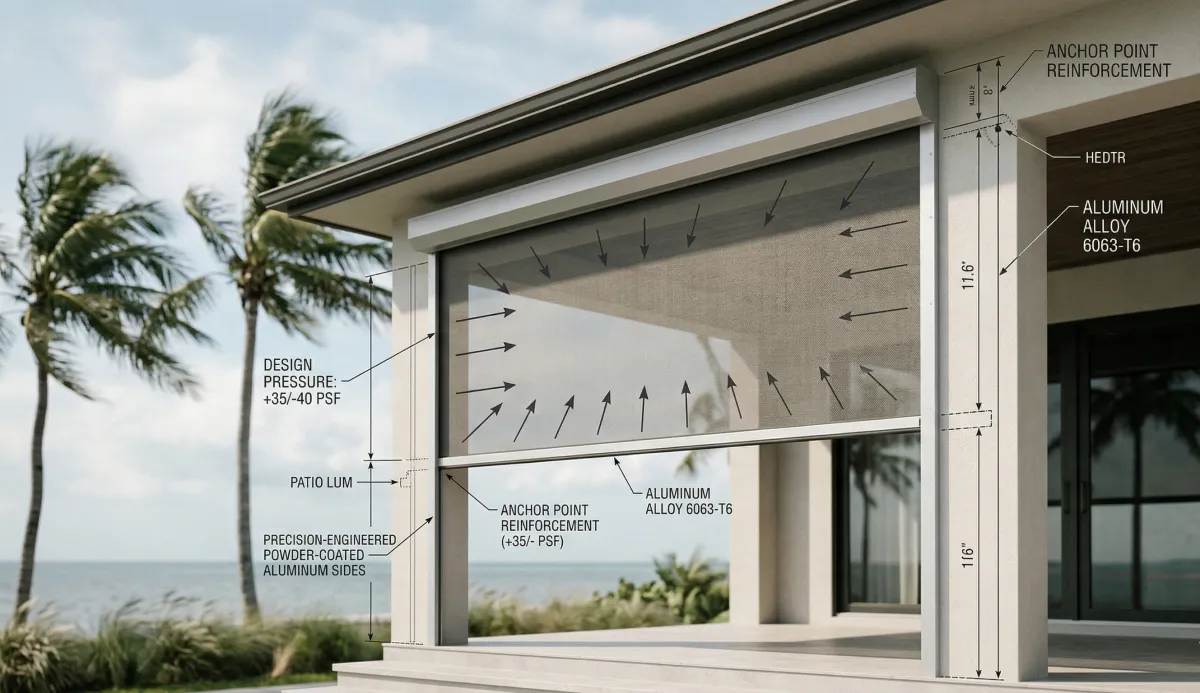
Motorized Screen Wind Load Specifications: A Technical Guide for Builders
Why Wind Load Calculations Must Come Before the Purchase Order
Motorized screens are a permanent component of the building envelope. They are not furniture, and they are not accessories. Once installed, they are subject to the same wind load requirements as windows, doors, and glazed curtain wall assemblies. A builder who specifies a motorized screen system without first completing wind load calculations is not cutting a corner: they are potentially installing a non-compliant assembly into a permitted structure.
That outcome carries consequences ranging from failed inspections to liability exposure on warranty claims. The correct sequence begins with the structural environment, not the product catalog.
This guide provides builders with the technical framework for specifying motorized screens correctly: from determining the design wind pressure at a specific project site, through reading product approval documentation, understanding exposure category classifications, and coordinating the screen specification with structural substrates. The resource at Next Gen Screens exists precisely for this purpose: to give builders the specifications, standards, and technical data needed to get these installations right from permit submission through final inspection.
The Governing Standard: ASCE 7-22 and Design Wind Pressure
All wind load calculations for motorized screen specifications in the United States begin with ASCE 7-22: Minimum Design Loads and Associated Criteria for Buildings and Other Structures, published by the American Society of Civil Engineers. ASCE 7-22 is the referenced standard in both the International Building Code (IBC) and the Florida Building Code, 8th Edition (2023), making it the applicable baseline for virtually every jurisdiction where builders encounter motorized screen specifications.
For builders, the most relevant section of ASCE 7-22 is Chapter 30: Wind Loads on Components and Cladding (C&C). Motorized screens, when installed in exterior openings, function as components and cladding elements. They are not primary structural members, but they form part of the building envelope's pressure boundary and must be specified to resist the design wind pressures applicable to their location.
The Four Variables That Determine Design Wind Pressure
Design wind pressure (p) for a component and cladding element is expressed in pounds per square foot (psf) and is calculated using the following four inputs.
1. Basic Wind Speed (V) The basic wind speed for a project site is obtained from the ASCE 7-22 wind speed maps, which define three-second peak gust velocities at 33 feet above grade for Exposure Category C terrain. In coastal Florida, basic wind speeds range from 130 mph in northern regions to 185 mph or greater in Miami-Dade and Monroe Counties. Builders should verify the applicable wind speed using the Applied Technology Council's Hazards by Location tool, which provides site-specific ASCE 7 wind speed data by address.
2. Exposure Category Exposure category accounts for the surface roughness of the terrain surrounding the building. ASCE 7-22 defines three categories applicable to most construction:
Exposure B: Urban and suburban areas, wooded areas; buildings 30 feet or less in height
Exposure C: Open terrain with scattered obstructions less than 30 feet in height; coastal areas above the high tide line
Exposure D: Flat, unobstructed areas directly exposed to wind flowing over open water; immediate coastline and barrier islands
The majority of residential and light commercial construction in Florida and along the Gulf Coast falls within Exposure C or D. Builders must confirm the applicable exposure category before completing wind pressure calculations. Assigning the wrong exposure category is one of the most common specification errors in coastal construction.
3. Roof Height and Zone Classification ASCE 7-22 Chapter 30 assigns higher wind pressures to screen and glazing assemblies located in corner zones (Zone 5) versus field zones (Zone 4) of a building's exterior. Corner zones are defined by a distance equal to the lesser of 10 percent of the building's least horizontal dimension or 40 percent of the mean roof height, but not less than 4 percent of the least horizontal dimension or 3 feet. Motorized screens installed near building corners must be specified to the higher Zone 5 pressures.
4. Effective Wind Area and Pressure Coefficients External and internal pressure coefficients (GCp) are tabulated in ASCE 7-22 Figure 30.3-1 for enclosed buildings. These coefficients vary with effective wind area, which is the area of the component tributary to the wind pressure being calculated. For motorized screens spanning large openings, effective wind area may exceed 100 square feet, which reduces the applicable GCp value and, consequently, the design wind pressure.
Applying the Calculation
The design wind pressure equation from ASCE 7-22 Section 30.3.2 is:
p = qh (GCp – GCpi)
Where:
qh = velocity pressure at mean roof height, calculated from the basic wind speed and exposure category
GCp = external pressure coefficient from tabulated values
GCpi = internal pressure coefficient (±0.18 for enclosed buildings; ±0.55 for partially enclosed buildings)
Builders should obtain design wind pressure values from the project's structural engineer of record or from the product approval documentation for the specific motorized screen system being specified. Product approvals published by the Florida Building Commission include the tested design pressures, expressed in psf, against which the product has been certified.
Reading Florida Building Code Product Approval Documentation
In Florida, motorized screens installed as exterior opening protection must carry a valid Florida Building Code Product Approval under Florida Statute 553.842 and Florida Administrative Code Rule 61G20. This is a non-negotiable requirement for permitted construction. The product approval confirms that the screen system has been tested to the applicable wind load and, where required, impact resistance standards.
What a Product Approval Number Tells the Builder
Every approved product is assigned a Florida Product Approval (FL) number. The approval document contains:
The maximum positive and negative design wind pressures (psf) for which the product is certified
The applicable ASTM and TAS testing standards to which the product was tested
The installation requirements that must be followed for the approval to remain valid
The substrate types (masonry, wood frame, steel) for which the installation is approved
The approved dimensions and configurations (width, height, motor position)
Builders must verify that the design wind pressures in the product approval meet or exceed the design wind pressures calculated for the specific project site and zone classification. If the project's calculated design pressure is 55 psf negative and the product approval is certified to 50 psf negative, the product does not comply, regardless of its marketing claims.
The Florida Building Commission's product approval search database allows builders to search by FL number, manufacturer, or product category. Motorized screen systems are listed under the category "Exterior Doors and Windows: Shutters."
HVHZ: The Separate Standard for Miami-Dade and Broward Counties
Florida's High-Velocity Hurricane Zone (HVHZ) applies to Miami-Dade and Broward Counties and requires a higher level of product certification than the statewide Florida Product Approval system. In the HVHZ, products must carry a Miami-Dade County Notice of Acceptance (NOA), issued by the Miami-Dade County Building Code Compliance Office.
NOA testing requirements include the Miami-Dade Test Application Standards:
TAS 201: Large missile impact test (9-lb two-by-four at 50 fps)
TAS 202: Uniform static air pressure test
TAS 203: Cyclic wind pressure loading test
For builders working in Miami-Dade or Broward Counties, the NOA is the required document; a statewide Florida Product Approval is not sufficient. Builders specifying motorized screens with hurricane-rated performance for HVHZ projects should reference Max Force Hurricane Screens for systems carrying HVHZ-compliant NOA documentation.
Specifying Motorized Screens for Your Next Project?
One Track's technical resources include product data sheets, installation guides, and specification documentation formatted for permit submittal packages. Explore One Track's professional resources at onetrackscreens.com
Structural Substrate Classification and Anchor Requirements
The product approval is only half of the structural specification equation. The other half is the substrate: the material to which the motorized screen's header, track, and sill components are anchored. An approved product installed into an inadequate substrate with undersized fasteners is a failed installation, regardless of the product's certification status.
Substrate Categories and Their Implications for Builders
Masonry (Concrete Block, Concrete, Brick) Masonry substrates require anchoring into solid material or structural cores. Hollow block requires anchors rated for hollow substrate applications. Minimum embedment depths are specified in the product approval; typical values range from 1.25 inches to 2.5 inches depending on the anchor type and the calculated uplift and shear loads. Builders must confirm that the block course receiving the anchor is grouted solid where required by the product approval installation details.
Wood Frame Construction Wood frame substrates require attachment to structural members: headers, jambs, or rim joists with adequate cross-section to resist the applied loads. The product approval specifies minimum lumber dimensions and fastener schedules. Attachment to sheathing or non-structural framing elements is not permissible under most product approval installation requirements.
Steel and Aluminum Framing Curtain wall and storefront systems used in commercial construction require coordination with the glazing contractor. Motorized screen headers and tracks must attach to structural framing members, not to the glazing infill. This coordination is best addressed during the construction document phase, not during field installation.
The Anchor Calculation Requirement
For large motorized screen openings, the applied wind loads on the header and track system can be substantial. A screen assembly spanning a 16-foot opening under a design wind pressure of 60 psf negative generates a total load of approximately 5,760 pounds distributed across the header attachment points. Builders specifying large-span installations should request anchor calculations from the screen manufacturer or the project's structural engineer of record to confirm that the substrate and fastener schedule are adequate for the applied loads.
Coordinating the Motorized Screen Specification in the Construction Document Set
Motorized screen specifications belong in the construction document set, not in a post-construction allowance. Retrofitting screens into a structure that was not designed to receive them creates field coordination problems that consistently result in non-compliant installations, change order costs, and schedule delays.
Where Motorized Screen Data Belongs in the CD Set
Architectural Drawings
Exterior elevations: indicate screen location, approximate cassette housing dimensions, and opening dimensions
Details: show header pocket framing or blocking, sill channel configuration, and clearances from adjacent construction
Window and door schedule: include a motorized screen column with product approval number and design pressure rating
Structural Drawings
Confirm header framing or beam size is adequate to support the screen dead load and the transferred wind load
Note substrate preparation requirements (grouted cores in masonry, solid blocking in wood frame) at all screen attachment locations
Electrical Drawings
120V or low-voltage power supply to each motor location
Conduit routing from motor to wall control or smart home integration point
Specify whether the circuit is dedicated or shared, and note any smart home integration requirements
Specifications (Division 10) Motorized screens are typically specified under CSI MasterFormat Division 10 28 00 (Exterior Sun Control Devices) or Division 08 71 00 (Door Hardware), depending on the project's specification organization. The specification section should include the product approval number, the required design pressure rating, the motor specification, and the installation requirements referenced directly from the product approval document.
Pre-Construction Coordination Checklist for Builders
The following items should be confirmed before motorized screen installation begins on any permitted project. Treating this as a pre-construction coordination checklist, rather than a punch-list item, eliminates the field problems that drive the majority of motorized screen installation failures.
Structural Coordination
Design wind pressure calculated for the project site, exposure category, and building zone (confirm against ASCE 7-22 Chapter 30)
Product approval or NOA confirmed; design pressure in the approval equals or exceeds the calculated design pressure
Header pocket or blocking installed to the dimensions specified in the product approval installation drawings
Substrate type confirmed; masonry cores grouted solid where required; wood framing members of adequate dimension
Electrical Coordination
Power supply installed and accessible at each motor location before the screen cassette is mounted
Conduit stub-out positioned per the motor manufacturer's rough-in requirements
Smart home integration wiring (RS-485, low-voltage bus) pulled to motor locations if building automation integration is specified
Dimensional Coordination
Rough opening dimensions confirmed against the product approval's approved size schedule
Header pocket depth confirmed against the cassette housing dimensions for the specified product
Clearance for motor service access confirmed on the drawings
Documentation
Product approval or NOA number recorded in the project's inspection documentation
Manufacturer's installation instructions on-site and available to the inspecting authority
Submittal package complete and approved before installation begins
For additional technical resources across the motorized screen category, the Next Gen Screens blog provides specification references, installation guides, and code compliance data organized by professional discipline.
Documentation for the Inspecting Authority
Building departments reviewing motorized screen installations as part of a permitted project will typically require the following documentation at rough inspection or final inspection, depending on the jurisdiction's process.
Florida jurisdictions (statewide):
Florida Product Approval number and printed approval document
Manufacturer's installation instructions (incorporated by reference into the product approval)
Anchor type, size, and spacing as installed
Miami-Dade and Broward Counties (HVHZ):
Miami-Dade NOA number and printed NOA document
TAS test reports on file with the county (publicly searchable via the Miami-Dade product search)
Inspector confirmation that the installation matches the NOA installation details
IBC jurisdictions outside Florida:
ASCE 7-22 design wind pressure calculation for the site
Test reports demonstrating performance at the calculated design pressure (ASTM E330 for structural load; ASTM E1886/E1996 for impact where required)
Manufacturer's installation instructions
Builders operating in jurisdictions with local amendments to the IBC or Florida Building Code should confirm with the local building official whether additional documentation is required before permit submission.
Conclusion: Specification Sequence Determines Installation Outcomes
Motorized screen wind load specifications are not a product selection task. They are a structural specification task that requires site data, code research, and document coordination before the first product is chosen. Builders who approach the specification in the correct sequence: wind speed determination, exposure category classification, design pressure calculation, product approval verification, substrate coordination, and document preparation will produce permitted, inspected, and code-compliant installations.
Those who reverse the sequence, selecting a product first and verifying compliance afterward, produce change orders, inspection failures, and liability exposure.
The technical resources at Next Gen Screens are organized around the professional's workflow, not the consumer's purchase journey. Specification data, product approval references, installation guides, and code compliance documentation are available as working resources for builders coordinating motorized screen systems into permitted construction.
Ready to submit your motorized screen specification package? Connect with a Next Gen Screens technical representative for project-specific guidance and submittal documentation support. Visit nextgenscreens.com to access the full resource library.